• Skip to primary navigation
  • Skip to main content
  • Skip to primary sidebar
  • Skip to footer

Bowdoin Science Journal

  • Home
  • About
    • Our Mission
    • Our Staff
  • Sections
    • Biology
    • Chemistry and Biochemistry
    • Math and Physics
    • Computer Science and Technology
    • Environmental Science and EOS
    • Honors Projects
    • Psychology and Neuroscience
  • Contact Us
  • Fun Links
  • Subscribe

Olivia Miller '27

New Cancer Vaccine Harnesses the Human Immune System

April 21, 2024 by Olivia Miller '27

Right now, cancer is the second most common cause of death in the world, and it’s set to become the leading cause within the next several decades (Drexler) (Figure 1). Unlike many other diseases that have plagued humans throughout our history, even revolutionary advancements in medicine have not been able to fully prevent or cure it. To understand why, it’s important to recognize that cancer comes not from the outside, but from within ourselves, when our own cells begin to divide uncontrollably and spread throughout our bodies. Because cancer arises in our bodies, we can’t treat it using antibiotics or vaccines that target a particular pathogen. However, a 2023 study has proposed a new vaccine treatment that fights pancreatic cancer (which has a five-year survival rate of only 12%) using our own immune system.
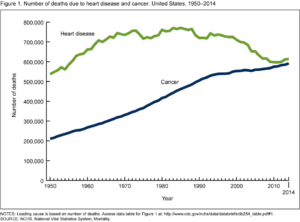
Figure 1. Cancer deaths are expected to surpass deaths due to heart disease in the United States. Source: CDC

To understand this discovery, it’s important to learn a little about how the immune system works. One important component of our body’s defense system are our T cells, which fight invaders by identifying and killing body cells infected with pathogens such as viruses. A T cell only knows what to attack after it’s activated by a foreign particle called an antigen. Antigens are often tiny pieces of invading viruses or bacteria, like “keys” which unlock a T cell immune response. Now, what does all this have to do with cancer? The idea behind this proposed treatment is to use neoantigens (a type of antigen) to help the body recognize cancer cells. Neoantigens are mutant proteins which only form on tumor cells, so helping T cells recognize them could help the body learn to attack cancerous cells.
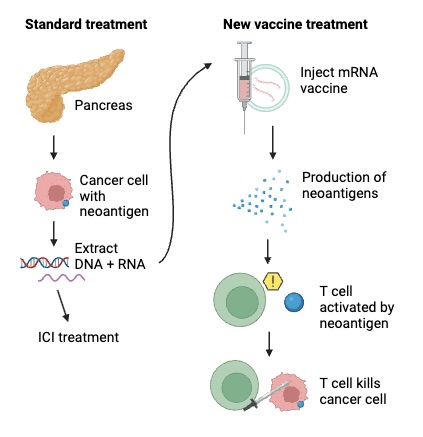
Figure 2. In combination with ICI treatment, these novel mRNA vaccines prompt the immune system to attack cancer cells by manufacturing the neoantigens on their surface. Adapted from Huff & Zaidi (2023) and created with BioRender.com.

This study’s major discovery was a new way to prompt the immune system to recognize neoantigens. The researchers took genetic material (such as DNA and RNA) from the surgically removed tumors of sixteen people with pancreatic cancer. Then they gave each patient a kind of treatment called an immune-checkpoint inhibitor (ICI). Immune checkpoints are proteins on the surfaces of healthy cells which usually tell our T cells not to attack them. The problem is that sometimes, immune checkpoints on cancerous cells prevent T cells from attacking them too. ICIs can treat some kinds of cancers by blocking these interactions between T cells and cancerous cells, allowing T cells to kill them, but they often do not work well on pancreatic cancer. To solve this problem, the researchers used the genetic information collected from the tumors to create a personalized vaccine containing mRNA (a type of RNA) that codes for the exact neoantigen formed on an individual’s cancer cells. After receiving this vaccine, a person’s cells would be able to use the mRNA to produce this neoantigen in abundance. Then, their T cells could theoretically recognize it, become activated, and know to go after the cancer cells with the neoantigen on their surfaces (Figure 2). To maximize the chances of triggering this T cell response, the vaccines included mRNA coding for as many as twenty neoantigens.

Now for the big question: did it work? Well, cancer unfortunately came back an average of 13.4 months after treatment for half of the study’s participants. The other eight, however, all had T cells which recognized the artificial neoantigens in their bodies after vaccine treatment and also remained cancer-free after ~18 months (Huff & Zaidi, 2023). This vaccine is clearly not perfect, and future research is still needed to understand why half the patients’ immune systems did not respond to the treatment. However, it is still an incredible breakthrough that could shift the direction of cancer treatment. A clinical trial, the second phase of this study, is already well underway and includes over 250 patients (Stallard, 2024). Given the small sample size of this first study, the new clinical trial will help clarify how effective this vaccine treatment really is. Immunotherapy is emerging as a leading factor in the fight against cancer, and this study gives reason to believe that new treatment possibilities could be on the horizon for cancer patients, even those with aggressive tumors.


References

Drexler, M. (n.d.). The Cancer Miracle Isn’t a Cure. It’s Prevention. Harvard Public Health. https://www.hsph.harvard.edu/magazine/magazine_article/the-cancer-miracle-isnt-a-cure-its-prevention/. 

Heron, M. & Anderson, R.N. (2016). Changes in the leading cause of death: Recent patterns in heart disease and cancer mortality. CDC: NCHS data brief, 254. https://www.cdc.gov/nchs/products/databriefs/db254.htm.

Huff, A.L. & Zaidi, N. (2023, May 10). Vaccine boosts T cells that target pancreatic tumours. Nature. https://www.nature.com/articles/d41586-023-01526-8.

Rojas, L.A., Sethna, Z., Soares, K.C. et al. (2023). Personalized RNA neoantigen vaccines stimulate T cells in pancreatic cancer. Nature 618, 144–150. https://doi.org/10.1038/s41586-023-06063-y. 

Stallard, J. (2024, April 7). Investigational mRNA Vaccine Induced Persistent Immune Response in Phase 1 Trial of Patients With Pancreatic Cancer. Memorial Sloan Kettering Cancer Center. https://www.mskcc.org/news/can-mrna-vaccines-fight-pancreatic-cancer-msk-clinical-researchers-are-trying-find-out.
Filed Under: Biology, Science

Are Kids Innately Helpful? The Bystander Effect in Children

December 3, 2023 by Olivia Miller '27

Many of us reflect on our childhoods as a time of blissful lack of social inhibition. As kids, we are often unaffected by the sense of embarrassment and self-consciousness which can hold us back as adults. This lack of social inhibition could explain why kids — even those as young as one year old — seem to have an inherent inclination to be helpful towards others (Plötner et al., 2015, p. 500). In fact, psychological forces which lead adults to resist offering their help can have a very different effect on kids. One such example is the bystander effect, which suggests that people are less likely to jump in and help someone in need when other onlookers are present. A previous study showed that the presence of bystanders can actually make children more likely to help (Plötner et al., 2015, p. 500). Researchers have identified three forces which may contribute to the bystander effect: social referencing, diffusion of responsibility, and shyness to act in front of others. Maria Plötner and colleagues recently conducted a study on the impact of diffusion of responsibility — the feeling of decreased sense of duty to help when more people are around — on children’s willingness to help an adult in need. The study calls into question our previous conceptions of kids as innately helpful, suggesting that children as young as five may be less likely to engage in helping behavior in the presence of other bystanders.

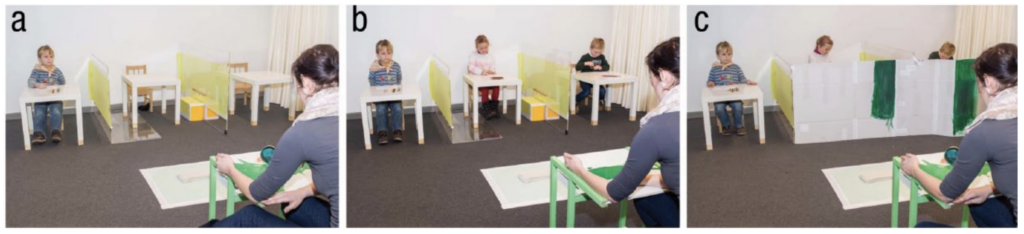
The researchers recruited sixty five-year-old participants to be assigned randomly to one of three conditions. In all conditions, the experimenter told the children that they were going to color a picture while she painted a cardboard wall. The test of helping came in after about thirty seconds, when the experimenter spilled her cup of dirty paint water all over her table. At regular intervals, she recited scripted dialogue (“oops,” “my cup has fallen over,” etc.) to let the children know she needed their help getting paper towels, which she had used to clean something up at the start of the experiment but were now out of her reach (Plötner et al., 2015, p. 501–502).

Figure 1. The alone (a), bystander (b), and bystander-unavailable (c) conditions.

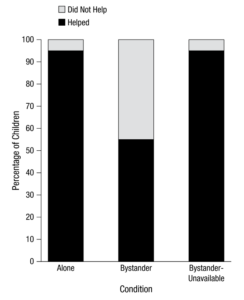
For each of the three conditions, the researchers recorded whether or not children helped the experimenter by bringing her a paper towel. The first was the “alone” condition, which was identical to the other two except for the fact that, as you might guess, there were no other children present. When they were alone, the subjects helped the experimenter about ninety five percent of the time (Plötner et al., 2015, p. 503). On the other hand, in the “bystander” condition, two “confederates” — other children in on the study — were present when the experimenter spilled her water and did nothing to help her. Here only about fifty five percent of subjects helped (Plötner et al., 2015, p. 503). Some might account for this difference using the concept of social referencing, our tendency to look to others when an emergency or accident takes place. When those around us seem not to notice or care about what’s happening, we use their behavior to inform our own. It’s easy to see how this could make the five-year-old subjects much less likely to bring the experimenter a paper towel, considering that the confederates had seen what happened but were completely indifferent to the experimenter’s distress.

Figure 2. The percentage of children who helped in each of the three conditions.

But this study’s third condition, termed “bystander-unavailable,” put the social referencing explanation to the test. In this condition, while two other children were present, they were seated in such a way that they were physically unable to get up and help the experimenter (see Figure 1). Lo and behold, the children were much more likely to help when the other bystanders were “unavailable” than when they were also able to help. In fact, subjects helped just as often in the bystander-unavailable condition as when they were alone (Figure 2) (Plötner et al., 2015, p. 503). So social referencing really couldn’t explain why bystanders made the children less likely to help, since they were able to observe others’ indifference toward the experimenter in both bystander conditions. And if shyness to act in front of others had made the difference, we would have seen a low likelihood to help whenever others were present, not just in the regular bystander condition. So the researchers concluded that the diffusion of responsibility was the key force limiting these five-year-olds’ tendency to help while in the presence of others.

This study presents a novel discovery of the ability of even young children to dismiss their own sense of duty when they know they are not the only ones able to help. More broadly, it highlights the important role of taking responsibility for helping others in motivating us to actually step in. Meta-analyses of other studies on the subject have emphasized this, showing that people are less likely to take responsibility for helping when more bystanders are present and when “the need for help is ambiguous” (Plötner et al., 2015, p. 500). While it may not be possible to overcome the seemingly innate phenomenon of the bystander effect, being aware of it may allow us to take responsibility and offer our help in moments of need.

References

Plötner, M., Over, H., Carpenter, M., & Tomasello, M. (2015). Young Children Show the Bystander Effect in Helping Situations. Psychological Science, 26(4), 499-506. https://doi.org/10.1177/0956797615569579

Filed Under: Psychology and Neuroscience, Science Tagged With: bystander effect, child psychology, diffusion of responsibility

Primary Sidebar

CATEGORY CLOUD

Biology Chemistry and Biochemistry Computer Science and Tech Environmental Science and EOS Honors Projects Math and Physics Psychology and Neuroscience Science

RECENT POSTS

  • Venom As Medicine: Novel Pathways for Dravet Syndrome Treatment Using Modulatory Peptides from Scorpion Venom January 8, 2026
  • When Distraction Helps: Music as a Tool for Focus in ADHD Cases December 24, 2025
  • Timing Matters: How the menstrual cycle influences ACL injury in Female athletes December 24, 2025

FOLLOW US

  • Facebook
  • Twitter

Footer

TAGS

AI AI ethics Alzheimer's Disease antibiotics artificial intelligence bacteria Bathymetry Biology brain Cancer Biology Cell Biology Chemistry and Biochemistry Chlorofluorocarbons climate change Computer Science and Tech CRISPR Cytoskeleton Depression Dermatology dreams epigenetics Ethics Genes Gut microbiota honors Marine Biology Marine Mammals Marine noise Medicine memory Montreal Protocol Moss neurobiology neuroscience Nutrients Ozone hole Plants Psychology and Neuroscience REM seabirds sleep student Technology therapy Women's health

Copyright © 2026 · students.bowdoin.edu