• Skip to primary navigation
  • Skip to main content
  • Skip to primary sidebar
  • Skip to footer

Bowdoin Science Journal

  • Home
  • About
    • Our Mission
    • Our Staff
  • Sections
    • Biology
    • Chemistry and Biochemistry
    • Math and Physics
    • Computer Science and Technology
    • Environmental Science and EOS
    • Honors Projects
    • Psychology and Neuroscience
  • Contact Us
  • Fun Links
  • Subscribe

Cell Biology

LiNx: A Dual-Pronged Approach to Cancer Immunotherapy

May 3, 2026 by Sebastian Ortiz Gonzalez

Diagram showing LiNx mechanism. It's delivered into the body, transfects non-APCs, enters an APC and is processed and presented through MHC1 or MHC2 pathways

mRNA vaccines have emerged from the COVID-19 pandemic as a promising approach to fighting infectious diseases (Kutikuppala et al. 2024). Different from traditional vaccines, which use a weakened version of a virus, mRNA vaccines deliver an mRNA corresponding to a protein on the surface of the virus. This mRNA allows our immune system to recognize and make small parts of the virus so that it can create antibodies to combat it (Cleveland Clinic 2024). However, mRNA is an unstable and negatively charged molecule, so it must be encased with some type of transport protection to prevent its degradation during delivery (Kutikuppala et al. 2024).

Lipid nanoparticles, or LNPs, have gained popularity in recent years as an effective delivery platform for mRNA vaccines due to their highly tunable composition and their ability to prevent nucleic acid degradation (Xu et al., 2025). One popular example is the utilization of LNPs in the Moderna mRNA-1273 COVID vaccine, where mRNA encoding the protein on the outside of the virus that is recognized by the immune system was encapsulated in an LNP. Vaccination with this LNP-encapsulated mRNA resulted in 90% lower risk of contracting COVID within 21 days for those over the age of 16, demonstrating the power and possibility of this technology (Noor, 2021).

LNPs are extremely small particles composed of: 1) ionizable lipids, which act as a case for the nucleic acid being delivered; 2) phospholipids regulating cell membrane fusion; 3) PEG-lipids and 4) cholesterol which both affect its size and stability (Figure 1) (Xu et al., 2025). An LNP’s formulation can have substantial effects on its ability to avoid cellular barriers for vaccine mRNA entry to a targeted area. For example, degradation of LNPs by enzymes and/or other immune cells after entering the body can affect a vaccine’s ability to reach the targeted tissue (Hou et al., 2021). This is especially critical for scientists working on immunotherapies, as a variation in lipid composition can determine whether the LNP will be taken up by immune cells like dendritic cells or other antigen-presenting cells, which present the LNP to other immune cells and start the immune response (Hou et al., 2021). 
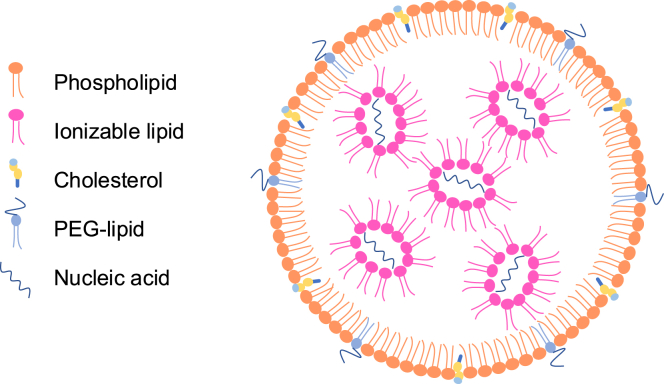
 

Figure showing the composition of LNPs. Phospholipid bilayer with cholesterol surrounds the LNP, which contains nucleic acid encapsulated within ionizable lipids
Figure 1. Composition of lipid nanoparticles. Adapted from 2025 Xu et al.

Hydrogels have also been utilized by scientists as vaccine carriers that can also augment immune responses. Hydrogels are natural or synthetic materials containing a 3D network of cross-linked polymer chains that allow them to absorb large amounts of a target substance (Ho et al. 2022). Depending on the composition of the hydrogel, scientists have found evidence of greatly increased immune cell recruitment and prolonged immune memory in mouse models of melanoma after a hydrogel-based vaccine was delivered (Kerr et al., 2023; Pal et al., 2024). In other words, the immune response was stronger and also more effective upon encountering a pathogen a second time. Therefore, if a hydrogel were to be used to deliver an LNP, finding the right composition is extremely important, as it can greatly impact its efficacy.

In their paper, Zhu et al. report the effectiveness of LiNx, a nanofiber-hydrogel composite (NHC) mRNA LNP matrix, in tumor and melanoma mouse models. Essentially, they embedded their LNPs within the 3D network of extremely small and cross-linked fibers in a hydrogel to significantly boost the immune response to cancer. 

LiNx works as a subcutaneous injection combining the potent immune activation capability of LNPs with the immunostimulatory microenvironment provided by the NHC. While the NHC recruits immune cells to the injection site and promotes immune cell signaling, the LNPs introduce nearby cells to the encapsulated mRNA, resulting in a coordinated adaptive immune response (Figure 2).
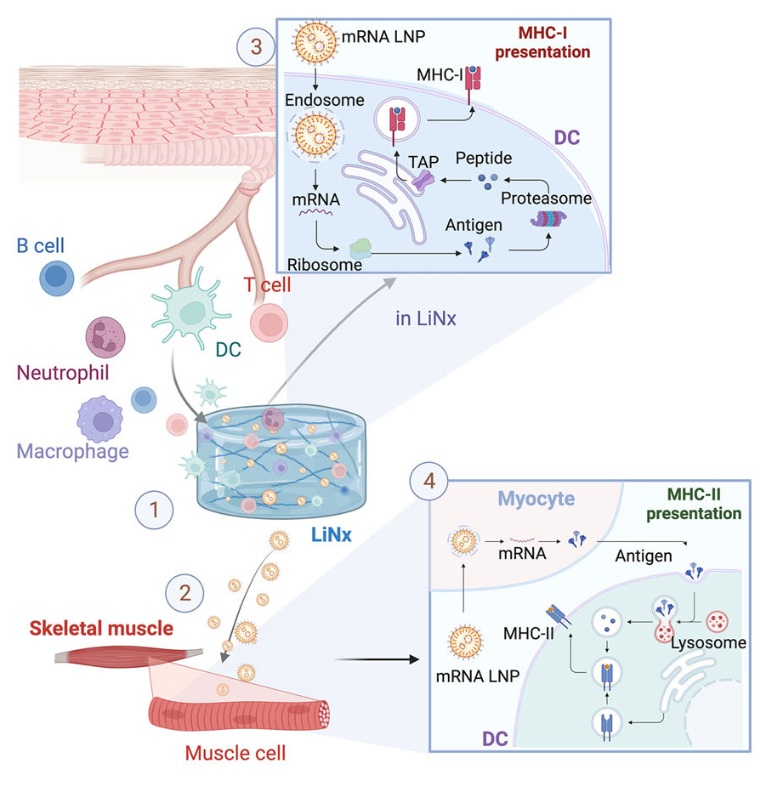
Diagram showing LiNx mechanism. It's delivered into the body, transfects non-APCs, enters an APC and is processed and presented through MHC1 or MHC2 pathways
Figure 2. Diagram of LiNx mechanism. (1) LiNx is delivered into the body and (2) transfects non-antigen-presenting cells. (3) The LNP enters an antigen-presenting cell, and the mRNA within is processed and presented through (4) two different pathways. Adapted from 2025 Zhu et al.

The lipid composition of LNPs can affect not only their size and stability, but also their transfection and delivery efficacy, or their ability to deliver the vaccine mRNA into host cells like dendritic cells (which start the immune response). To identify the top-performing LNP formulations, the researchers screened over one thousand different lipid compositions. Three top-performing LNP formulations were identified based on their transfection efficiency in bone marrow-derived dendritic cells: C10, D6, and F5. All of these formulations also separately activated powerful Th1 responses, a type of immune response meant to eliminate bacteria, viruses, and cancer cells, after three doses of subcutaneous injections.  

To simply quantify the host cell recruitment and transfection profile of the three different formulations, the researchers injected LiNx containing C10, D6, or F5 LNP into mice and measured the present immune cells 3 and 7 days post-injection. At both 3 and 7 days post-injection, a considerable amount of host cells were found in the NHC scaffold for all three formulations. The D6 formulation showed the greatest host cell recruitment, having a 12.6-fold increase compared to the control.

The researchers then performed a similar experiment, injecting mice with LiNx loaded with a test mRNA to get a better idea of the performance of each formulation compared to each other. They found that 10 days after injection, the D6 formulation contained over one-hundred-fold more transfected cells than C10 and F5-mRNA LiNx. Fourteen days post-injection, the D6-mRNA LiNx was also found to have recruited a more diverse range of immune cells associated with robust and specific immune responses like T cells and B cells. On the other hand, the C10 and F5-mRNA LiNx recruited more immune cells associated with general immune responses, like neutrophils. This shows that the D6-mRNA LiNx induces a stronger and more customized immune response. Additionally, three months post-vaccination, there were 10x more central memory T cells present in the spleens of D6-mRNA mice compared to the control and other formulations, indicating a stronger long-term memory response. These results suggest that the D6 LiNx is the most efficient LiNx formulation. 

Having characterized the immune activation induced by D6-mRNA LiNx, the researchers then tested its effectiveness in cancer mouse models. Mice were inoculated with colorectal cancer cells and received vaccinations of one of the LiNx formulations four days later. These mice were administered the vaccines in a single dose, while a separate control group received three doses of only D6 LNPs. The negative control group received only the NHC and protein without the LNP. The median survival time of the single-dose D6 LiNx mice was 75 days compared to 31 days for the negative control group and 37.5 days for the three-dose group, underscoring a heightened tumor suppression response. Fifty percent of these mice remained tumor-free after 100 days. This experiment demonstrated LiNx’s anti-cancer potential in vivo. 

In their paper, Zhu et al. demonstrated the effectiveness of a dual-modal approach to cancer immunotherapy. Through the combination of lipid nanoparticle mRNA delivery and a hydrogel microenvironment, they were able to induce a substantially stronger immune response characterized by tumor suppression and long-term immune memory in mouse models. The superior performance of a singular dose of D6 LiNx compared to three LNP doses illustrates the promise found in combining delivery methods with immune-boosting materials for the future development of stronger and longer-lasting cancer immunotherapies.


References:

Ho T-C et al. 2022. Hydrogels: Properties and Applications in Biomedicine. Molecules. 27(9):2902. 

Hou X, Zaks T, Langer R, Dong Y. 2021. Lipid nanoparticles for mRNA delivery. Nat Rev Mater. 6(12):1078–1094. 

Kerr MD et al. 2023. Biodegradable scaffolds for enhancing vaccine delivery. Bioeng Transl Med. 8(6):e10591. 

Kutikuppala LVS et al. 2024. Prospects and Challenges in Developing mRNA Vaccines for Infectious Diseases and Oncogenic Viruses. Med Sci (Basel). 12(2):28. 

mRNA Vaccines: What They Are & How They Work. 2024. Cleveland Clinic; [accessed 2026 May 2]. https://my.clevelandclinic.org/health/treatments/21898-mrna-vaccines

Noor R. 2021. Developmental Status of the Potential Vaccines for the Mitigation of the COVID-19 Pandemic and a Focus on the Effectiveness of the Pfizer-BioNTech and Moderna mRNA Vaccines. Curr Clin Microbiol Rep. 8(3):178–185. 

Pal S et al. 2024. Extracellular Matrix Scaffold-Assisted Tumor Vaccines Induce Tumor Regression and Long-Term Immune Memory. Adv Mater. 36(15):e2309843. 

Xu S et al. 2025. Lipid nanoparticles: Composition, formulation, and application. Mol Ther Methods Clin Dev. 33(2):101463. 

Zhu Y et al. 2025. An mRNA lipid nanoparticle-incorporated nanofiber-hydrogel composite for cancer immunotherapy. Nat Commun. 16(1):5707. 



Filed Under: Biology, Chemistry and Biochemistry Tagged With: Cancer Biology, Cell Biology, Medicine

Uncovering Our Inner Overlord: How DEADbox ATPases Built Their Empire Off Regulating RNA Maturation

December 9, 2024 by Lia Scharnau '26

Do you remember the simple days? Recall your fond memories of learning about organelles in introductory biology. This is where we learned our favorite biology fact, that the mitochondria is the powerhouse of the cell. Sigh, those were the days. Well, recently the field of biology has discovered a new type of organelles in the cell; membraneless organelles! They are formed through liquid-liquid phase separation (LLPS). If you imagine the droplets formed when you combined oil and water, that’s a form of LLPS. Membraneless organelles rely on LLPS for rapid and reversible cell compartmentalization.

In 2019, researcher Maria Hondele and her team took particular interest in investigating membraneless organelles, focusing specifically on DEAD-box ATPases (DDX) and their role in regulating them. DEAD-box ATPases keep ribonucleoprotein complexes from misfolding or building up over time. The role of DDX-mediated phase separation in compartmentalizing RNA processing is a rare cellular organization conserved across prokaryotes and eukaryotes over time (Hondele 2022). Highly conserved proteins have withstood the test of evolution and have continued to be passed down through generations without significant mutation. Hondele looked specifically at RNA-dependent DEAD-box ATPases because they regulate the RNA movement in and out of the membraneless organelles.

This investigation focused on  Dhh1, which is a DEAD-box ATPase specific to Saccharomyces cerevisiae (yeast). A wide range of assays were run to systematically determine the conditions required for the in vitro formation of Dhh1 liquid droplets. Liquid droplets are formed through LLPs and are indicators of membraneless organelles. Hondele found that liquid droplet formation is a fickle process that requires specific amounts of RNA and ATP to be added to the system and the cell environment to be at a low pH and salt concentration (Hondele 2019). Additionally from a DNA standpoint, the DDX itself must have low-complexity domain tails which means the ends of the proteins do not consist of a large variety of amino acids (Hondele 2019). 

After the initial investigation of the DDX ATPase and how it runs controls Dhh1 droplet formation, Hondele, and her team investigated DDX ATPase’s role in the regulation of RNA. Through a series of experiments, they found that DDX ATPases have played an extensive role in RNA regulation. The DDX ATPases can actually control the RNA maturation steps so they become spatially and temporally separated in distinct membraneless organelles (Hondele 2019). This means that each membraneless organelle may specialize in one step of the RNA maturation process so that the RNA must move between different organelles throughout the process. Of course, the release and transfer of RNA is regulated by ATPase activity, confirming DDX ATPase’s role as the omnipotent overlord of RNA. The DDXs derive their power from the low-complexity domains. These domains give DDXs the intrinsic ability to set up distinct compartments and when teamed up with the ATPases, they can influence the partitioning of RNA molecules between compartments (Hondele 2019).

Hondele and her team managed to uncover a complex and extensive dictatorship that has been operating for years under our very noses and in our very cells. The well-established and conserved cellular network of DEAD-box ATPases allows the RNA processing steps to be regulated, leading to DEAD-box ATPase control over maturation state, RNP composition, and ultimately RNA fate.

Unfortunately, we are still in the investigation phase and are yet to decide on how best to manipulate this dictatorship to benefit us. Current intelligence indicates that the dysregulation of DDXs could have pathological consequences that could contribute to the development of aggregation diseases, such as Parkinson’s, Alzheimer’s, Amyotrophic lateral sclerosis, and Frontotemporal Dementia (Gomes 2018). Luckily liquid-liquid phase separation has provided a mechanistic link between normal cellular function and disease phenotypes. Over time, these liquid droplets become more static and aggregated, likely leading these protein aggregates to be an end-stage phenotype after aberrant phase separation has overwhelmed cellular machinery that ordinarily reverses these altered phases (Gomes 2018). Through further study and comprehension of how DDXs contribute to these diseases, new treatments could be developed.


Literature Cited:

Gomes, E,. Shorter, J. The molecular language of membraneless organelles. J. Biol Chem. 2018; 294(18):7115-7127. 10.1074/jbc.TM118.001192

Hondele, M.,  Sachdev, R., Heinrich, S., Wang, J., Vallotton, P., Fontoura, B.M.A., Weis, K. DEAD-box ATPases are global regulators of phase-separated organelles. Nature. 2019; 573(7772):144-148. 10.1038/s41586-019-1502-y.

Hondele, M., Weis, K. The Role of DEAD-Box ATPases in Gene Expression and the Regulation of RNA-Protein Condensates. Annu Rev Biochem. 2022;  91:197-219. 10.1146/annurev-biochem-032620-105429. 

Filed Under: Biology, Science Tagged With: Biology, Cell Biology, Proteins

The Power of Plant Cells: An Interview with Luis Vidali, PhD

December 5, 2021 by Luke Taylor '24

Walking around campus, we are surrounded by plants of various sizes — pines, grass, bushes, mosses. Despite the variety of size and characteristics, all these plants share a similar structure: their cytoskeleton. The cytoskeleton is the protein fibers found within the liquid cytoplasm of plant cells that maintain and modify their physical structure. It performs the same function in plants as the bone skeleton does in animals. But how does it function? How does a tiny seed develop into a large, sturdy tree?  

On October 11th I met with Dr. Luis Vidali, a scientist researching mechanisms in plant cell growth and reproduction, with a focus on studying the cytoskeleton of the moss species Physcomitrium patens. Born in Mexico before moving to the US to continue his studies after college, Dr. Vidali received his doctorate at the University of Massachusetts, Amherst, and is currently Associate Professor of Biology and Biotechnology at the Worcester Polytechnic Institute in Worcester, MA. 


Interview Transcript*: 

*At the time of the interview verbatim quotes could not be recorded. This transcript is based on notes taken during the interview and the transcript was submitted to Professor Vidali prior to publication to make sure his words were accurately represented. 


Luke Taylor: If you were to explain the implications of your research to the general public in a few words or sentences, what would you say? 

Dr. Luis Vidali: I study how plant cells grow, especially how plant cells take up more space as they grow. Studying the growth of plant cells is important because plants are integral to our everyday lives- from providing food, fibers, and fuels. Plants are responsible for all of these and all plants are made of microscopic cells with defined shapes. If you want to understand how plants grow, you need to understand plant cell growth.  


LT: Why is moss such a good model? 

LV: The model I use is Physcomitrium patens: spreading earth moss. We want plant models that grow fast and have a short reproductive cycle, to expedite the pace of researching the cells. Additionally, plants have a reproduction cycle that consists of alternation of generations, where the gametophyte is haploid (has one copy of each chromosome in its cells) and the sporophyte is diploid (has double the number of chromosomes in its cells). The generation we use is primarily the gametophyte, so it having fewer chromosomes in its cell for each generation allows us to identify mutations in its genome and find a demonstrated phenotype much faster than with diploid cells. The moss cells will eventually become identical to each other, allowing for easy control of experimentation without self-breeding techniques.  


LT: How do you circumvent the alternation of generations cycle with moss cells if you primarily work with the gametophyte? 

LV: The diploid sporophyte of the moss we work with makes brown capsules. We are not interested in these capsules; we are interested in the more dominant gametophyte. The reason we can circumvent the alternation of generations is because the spores develop protonemata, which are the filaments of cells growing from the moss gametophyte. We grind the moss every week to prevent the sporophyte from developing and propagating spores. The tools we use to perform this grinding are blenders not too unlike the ones in a kitchen blender, but could use a two-shaft, two-probe homogenizer as well.  


LT: You state that the cytoskeleton is one of the most conserved structures in plants, animals, and fungi. From what you have researched in plant cytoskeletal structure and function, which functions in plant cytoskeletons do you think may be conserved (paralleled) by fungi and animals, and which structures and functions do you believe diverged? 

LV: Conserved structures in all eukaryotic cells include the separation of chromosomes by the microtubules in the mitotic spindle, and the polarized transport of vesicles  mediated by actin. In evolution, cell division divergence includes the use of the phragmoplast exclusively in some green algae and plants. The phragmoplast is a complex including microtubules and actin which mediates the production of the cell plate during cytokinesis of the plant cell. In contrast, fungi and animal cells use actin and myosin to make the contractile ring, which squeezes the two daughter cells apart. 


LT: Myosin is one of the proteins of study in your lab. From my understanding, myosin is associated with animal muscle cells. How does myosin in plant cells relate to myosin use in animal cells? 

LV: Plant cells only have two classes of myosin proteins, whereas animal cells have several more classes, the most abundant one is myosin II,  (Which explains why animal muscle contraction may be the first thing to come to mind when one hears of myosin. Myosin class II in animal cells make contractile filaments with actin, whereas myosin class I mediate vesicle transportation with actin. These myosins in animal cells are related to stress fibers and their contractile nature. Plant cells lack these myosins: they only have myosin class VIII and XI. Myosin class XI is functionally homologous with myosin class V. Myosin V was present within the last common ancestor between plants and animals and mediates the transport of vesicles. The presence of myosin XI in plant cells shows the conserved nature of vesicle transportation in eukaryotic cells. In fungi, class V, I, and II myosins are present. And class II has a function like the one in the contractile ring seen in animal cells. This is an example of the phylogenetic closeness of the fungi kingdom to the animal kingdom in comparison to the plant kingdom to the animal kingdom. Myosin VIII in plant cells specifically mediates vesicle transportation of the phragmoplasts and plasmodesmata, a function specific to plant cells.   


LT: You have a collaboration with the department of physics at WPI. What does this entail in terms of your research and methods? Do you find the interdisciplinary nature of your research to be more enlightening about phytological research? How do you apply the principles of physics in your research?  

LV: In my lab we use biophysical and mathematical techniques to model the diffusion of vesicles and molecules in the cell. To do this, we first need to measure the diffusion coefficient of the particles. The diffusion coefficient provides information of how fast particles are moving in space and has units of µm2/s. Because the motion of particles is difficult to measure directly, we instead use the diffusion coefficient to estimate how fast particles may cover a given area in space. By using the plane of coverage as a function of time, we know it takes longer for the molecule or vesicle with a larger diffusion coefficient to cover a larger space.  In our experiments, we use reaction-diffusion calculations to measure how long vesicles bind to myosin, and we see that the vesicles bind to the myosin for very brief periods of time. These mathematical and physical models of diffusion allow us to understand the systems better and model changes in the rate of vesicle transport and secretion. 

We also use physics and mathematics to study the mechanical properties of plant cell walls. For our purposes, we model plant cell walls as a thin shell of a complex polysaccharide matrix, which behaves like a balloon. Having osmotic pressure of the plant cell will apply turgor pressure to the wall of the cells, causing it to expand and assume a more rigid form. The level we study the cell wall at is at the material rather than molecular level, generally speaking. We use an elastic model for the material properties of the cell wall, including considering tensions, stressors, and strains from the turgor pressure on the wall from osmosis. The purpose of our model is to make predictions about how the plant cell behaves, and as we continue to test these predictions, we update our model’s parameters accordingly.  


Related papers by Dr. Vidali and colleagues:  

Bibeau, J.P., Furt, F., Mousavi, S.I., Kingsley, J.L., Levine,M.F., Tüzel, E. and Vidali, L. (2020) In vivo interactions between myosin XI, vesicles and filamentous actin are fast and transient in Physcomitrella patens. J. Cell Sci. (2020) 133, jcs234682 doi: 10.1242/jcs.234682  

Chelladurai, D., Galotto, G., Petitto, J., Vidali, L., and Wu, M. (2020). Inferring lateral tension distribution in wall structures of single cells. Eur Phys J Plus 135, 662. https://doi.org/10.1140/epjp/s13360-020-00670-8. 

Galotto, G., Abreu, I., Sherman, C.A., Liu, B., Gonzalez-Guerrero, M., and Vidali, L. (2020) Chitin triggers calcium-mediated immune response in the plant model Physcomitrella patens. Molecular Plant-Microbe Interactions. doi: 10.1094/MPMI-03-20-0064-R 

Kingsley, J.L., Bibeau, J.P., Mousavi, S.I., Unsal, C., Chen, Z., Huang, X., Vidali, L., and Tüzel, E. (2018) Characterization of cell boundary and confocal effects improves quantitative FRAP analysis. Biophysical Journal. 114:1153-1164. doi:10.1016/j.bpj.2018.01.01. 

Filed Under: Biology, Math and Physics, Science Tagged With: Cell Biology, Cytoskeleton, Luis Vidali, Moss, Plants

Primary Sidebar

CATEGORY CLOUD

Biology Chemistry and Biochemistry Computer Science and Tech Environmental Science and EOS Honors Projects Math and Physics Psychology and Neuroscience Science

RECENT POSTS

  • Carcinization: Is it Happening to Everybody? May 13, 2026
  • Efficacy of Neoantigen Vaccines against Triple Negative Breast Cancer May 12, 2026
  • New developments in understanding plankton transport May 12, 2026

FOLLOW US

  • Facebook
  • Twitter

Footer

TAGS

AI AI ethics Alzheimer's Disease antibiotics artificial intelligence bacteria Bathymetry Biology brain Cancer Biology Cell Biology Chemistry and Biochemistry Chlorofluorocarbons climate change cognitive Computer Science and Tech CRISPR Dentistry Depression Dermatology dreams emergency medicine epigenetics Ethics Genes Gut microbiota honors Marine Biology Marine Mammals Marine noise Medicine memory Montreal Protocol neurobiology neuron neuroscience Nutrients Ozone hole Psychology and Neuroscience seabirds sleep student Technology therapy Women's health

Copyright © 2026 · students.bowdoin.edu