By definition, plankton are small organisms that predominantly drift along with ocean currents. They typically swim slowly in relation to ocean currents. Plankton have been shown to exhibit gyrotaxis, which is directed locomotion to balance gravity and viscous torques, to passively alter their movements (Kessler, 1985). When performing this response, plankton experience net flow even in turbulence with no net flow by preferentially sampling turbulence fluctuations. In contrast to this original method of transport, Dibenedetto et al. theorized that plankton “surf” ocean currents by sensing and reorienting in response to the velocity gradient, doubling their net speed in turbulence (2025).
In their experiment, Dibenedetto et al. studied Crepidula fornicata, which are slipper snails with approximately spherical planktonic larvae that use cilia for movement. They tend to swim upwards to prevent sinking because their bottom-heaviness makes them negatively buoyant. Both early-stage (2 day-old) and late-stage (12 day-old) larvae were observed in a jet-stirred turbulence tank in a random order of low, medium, and high turbulence. They found that C. fornicata actively rotate to oppose local vorticity, or fluid rotation, contrasting with the typical passive response that is assumed (Vorticity – an Overview | ScienceDirect Topics, n.d.). They then compared these results to simulations of passive gyrotaxis, which is characterized by a reduction in upward swimming, and active surfing, which is characterized by an increased rate in upward swimming, because these methods cannot be isolated experimentally. They again found that C. fornicata behavior more closely aligns with surfing (DiBenedetto et al., 2025).
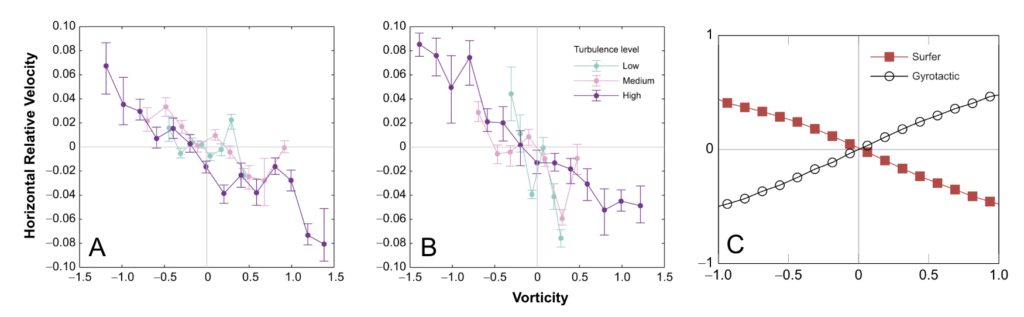
Dibenedetto et al. found a strong anti-correlation between plankton horizontal relative velocity and fluid vorticity in both age stages at all levels of turbulence (Figure 1). This is consistent with active surfing behavior because the flow’s vorticity and gravitational torque would tilt larvae counterclockwise due to their bottom-heaviness, but they actively resisted these forces and instead tilted clockwise. This behavior was more consistent in late-stage larvae. Furthermore, their velocity more closely resembles that of surfing rather than gyrotaxis in the simulation.
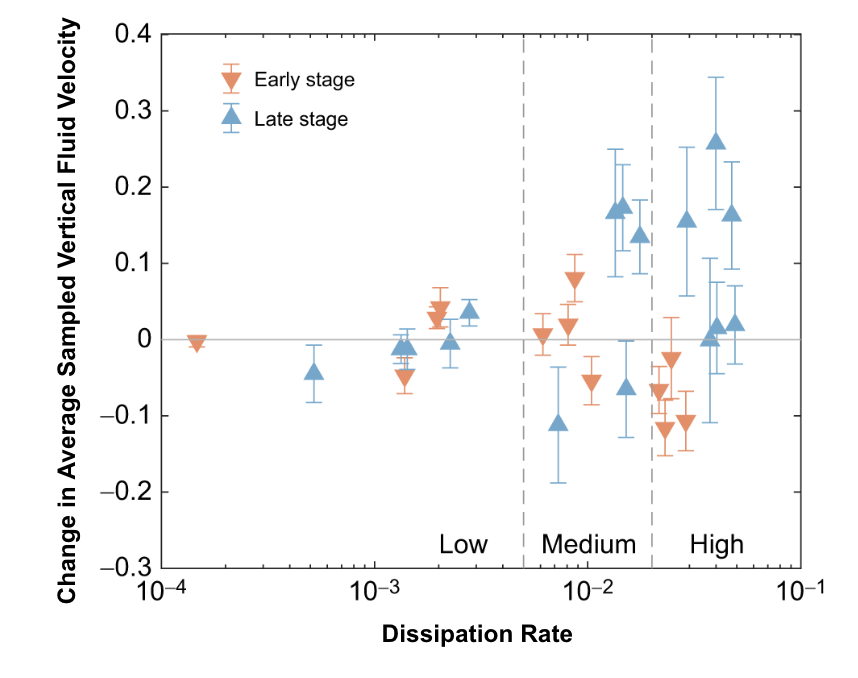
Additionally, they found that late-stage larvae preferentially sampled upwelling vertical velocities relative to mean fluid velocity (Figure 2). This was especially prevalent in higher turbulence levels. Early-stage larvae did not exhibit this behavior, indicating that they are not as skilled at surfing as late-stage larvae. Overall, this study found that passive reorientation models to describe plankton response to turbulence are often insufficient, as active surfing was exhibited in C. fornicata to increase the speed of their upward transport. Further research on the interplay between passive and active responses to turbulence is necessary to fully understand plankton transport. Plankton transport is valuable in allowing for the dispersal of planktonic larvae and supporting global marine food webs, as many organisms rely on consuming plankton for energy.
References