• Skip to primary navigation
  • Skip to main content
  • Skip to primary sidebar
  • Skip to footer

Bowdoin Science Journal

  • Home
  • About
    • Our Mission
    • Our Staff
  • Sections
    • Biology
    • Chemistry and Biochemistry
    • Math and Physics
    • Computer Science and Technology
    • Environmental Science and EOS
    • Honors Projects
    • Psychology and Neuroscience
  • Contact Us
  • Fun Links
  • Subscribe

Cancer Biology

LiNx: A Dual-Pronged Approach to Cancer Immunotherapy

May 3, 2026 by Sebastian Ortiz Gonzalez

Diagram showing LiNx mechanism. It's delivered into the body, transfects non-APCs, enters an APC and is processed and presented through MHC1 or MHC2 pathways

mRNA vaccines have emerged from the COVID-19 pandemic as a promising approach to fighting infectious diseases (Kutikuppala et al. 2024). Different from traditional vaccines, which use a weakened version of a virus, mRNA vaccines deliver an mRNA corresponding to a protein on the surface of the virus. This mRNA allows our immune system to recognize and make small parts of the virus so that it can create antibodies to combat it (Cleveland Clinic 2024). However, mRNA is an unstable and negatively charged molecule, so it must be encased with some type of transport protection to prevent its degradation during delivery (Kutikuppala et al. 2024).

Lipid nanoparticles, or LNPs, have gained popularity in recent years as an effective delivery platform for mRNA vaccines due to their highly tunable composition and their ability to prevent nucleic acid degradation (Xu et al., 2025). One popular example is the utilization of LNPs in the Moderna mRNA-1273 COVID vaccine, where mRNA encoding the protein on the outside of the virus that is recognized by the immune system was encapsulated in an LNP. Vaccination with this LNP-encapsulated mRNA resulted in 90% lower risk of contracting COVID within 21 days for those over the age of 16, demonstrating the power and possibility of this technology (Noor, 2021).

LNPs are extremely small particles composed of: 1) ionizable lipids, which act as a case for the nucleic acid being delivered; 2) phospholipids regulating cell membrane fusion; 3) PEG-lipids and 4) cholesterol which both affect its size and stability (Figure 1) (Xu et al., 2025). An LNP’s formulation can have substantial effects on its ability to avoid cellular barriers for vaccine mRNA entry to a targeted area. For example, degradation of LNPs by enzymes and/or other immune cells after entering the body can affect a vaccine’s ability to reach the targeted tissue (Hou et al., 2021). This is especially critical for scientists working on immunotherapies, as a variation in lipid composition can determine whether the LNP will be taken up by immune cells like dendritic cells or other antigen-presenting cells, which present the LNP to other immune cells and start the immune response (Hou et al., 2021). 
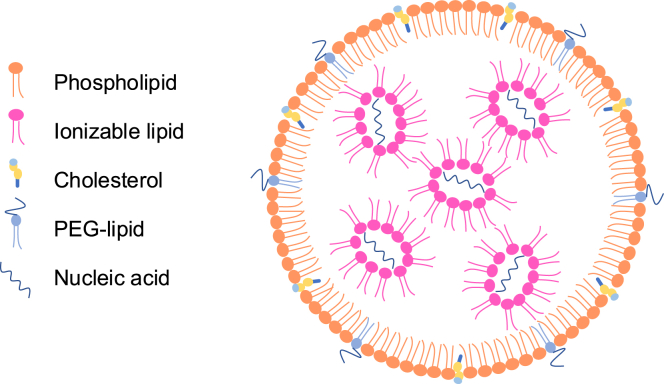
 

Figure showing the composition of LNPs. Phospholipid bilayer with cholesterol surrounds the LNP, which contains nucleic acid encapsulated within ionizable lipids
Figure 1. Composition of lipid nanoparticles. Adapted from 2025 Xu et al.

Hydrogels have also been utilized by scientists as vaccine carriers that can also augment immune responses. Hydrogels are natural or synthetic materials containing a 3D network of cross-linked polymer chains that allow them to absorb large amounts of a target substance (Ho et al. 2022). Depending on the composition of the hydrogel, scientists have found evidence of greatly increased immune cell recruitment and prolonged immune memory in mouse models of melanoma after a hydrogel-based vaccine was delivered (Kerr et al., 2023; Pal et al., 2024). In other words, the immune response was stronger and also more effective upon encountering a pathogen a second time. Therefore, if a hydrogel were to be used to deliver an LNP, finding the right composition is extremely important, as it can greatly impact its efficacy.

In their paper, Zhu et al. report the effectiveness of LiNx, a nanofiber-hydrogel composite (NHC) mRNA LNP matrix, in tumor and melanoma mouse models. Essentially, they embedded their LNPs within the 3D network of extremely small and cross-linked fibers in a hydrogel to significantly boost the immune response to cancer. 

LiNx works as a subcutaneous injection combining the potent immune activation capability of LNPs with the immunostimulatory microenvironment provided by the NHC. While the NHC recruits immune cells to the injection site and promotes immune cell signaling, the LNPs introduce nearby cells to the encapsulated mRNA, resulting in a coordinated adaptive immune response (Figure 2).
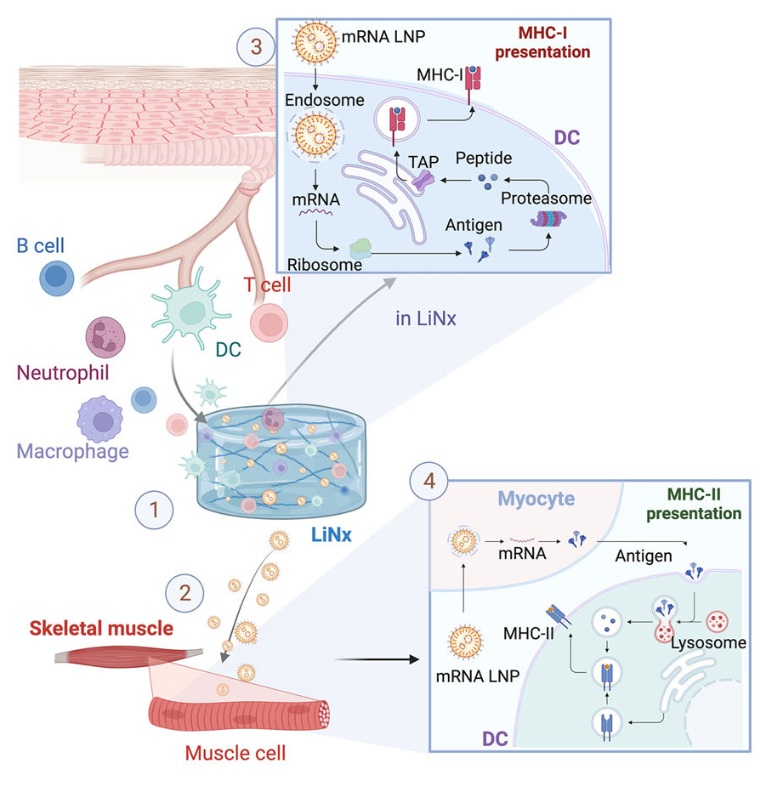
Diagram showing LiNx mechanism. It's delivered into the body, transfects non-APCs, enters an APC and is processed and presented through MHC1 or MHC2 pathways
Figure 2. Diagram of LiNx mechanism. (1) LiNx is delivered into the body and (2) transfects non-antigen-presenting cells. (3) The LNP enters an antigen-presenting cell, and the mRNA within is processed and presented through (4) two different pathways. Adapted from 2025 Zhu et al.

The lipid composition of LNPs can affect not only their size and stability, but also their transfection and delivery efficacy, or their ability to deliver the vaccine mRNA into host cells like dendritic cells (which start the immune response). To identify the top-performing LNP formulations, the researchers screened over one thousand different lipid compositions. Three top-performing LNP formulations were identified based on their transfection efficiency in bone marrow-derived dendritic cells: C10, D6, and F5. All of these formulations also separately activated powerful Th1 responses, a type of immune response meant to eliminate bacteria, viruses, and cancer cells, after three doses of subcutaneous injections.  

To simply quantify the host cell recruitment and transfection profile of the three different formulations, the researchers injected LiNx containing C10, D6, or F5 LNP into mice and measured the present immune cells 3 and 7 days post-injection. At both 3 and 7 days post-injection, a considerable amount of host cells were found in the NHC scaffold for all three formulations. The D6 formulation showed the greatest host cell recruitment, having a 12.6-fold increase compared to the control.

The researchers then performed a similar experiment, injecting mice with LiNx loaded with a test mRNA to get a better idea of the performance of each formulation compared to each other. They found that 10 days after injection, the D6 formulation contained over one-hundred-fold more transfected cells than C10 and F5-mRNA LiNx. Fourteen days post-injection, the D6-mRNA LiNx was also found to have recruited a more diverse range of immune cells associated with robust and specific immune responses like T cells and B cells. On the other hand, the C10 and F5-mRNA LiNx recruited more immune cells associated with general immune responses, like neutrophils. This shows that the D6-mRNA LiNx induces a stronger and more customized immune response. Additionally, three months post-vaccination, there were 10x more central memory T cells present in the spleens of D6-mRNA mice compared to the control and other formulations, indicating a stronger long-term memory response. These results suggest that the D6 LiNx is the most efficient LiNx formulation. 

Having characterized the immune activation induced by D6-mRNA LiNx, the researchers then tested its effectiveness in cancer mouse models. Mice were inoculated with colorectal cancer cells and received vaccinations of one of the LiNx formulations four days later. These mice were administered the vaccines in a single dose, while a separate control group received three doses of only D6 LNPs. The negative control group received only the NHC and protein without the LNP. The median survival time of the single-dose D6 LiNx mice was 75 days compared to 31 days for the negative control group and 37.5 days for the three-dose group, underscoring a heightened tumor suppression response. Fifty percent of these mice remained tumor-free after 100 days. This experiment demonstrated LiNx’s anti-cancer potential in vivo. 

In their paper, Zhu et al. demonstrated the effectiveness of a dual-modal approach to cancer immunotherapy. Through the combination of lipid nanoparticle mRNA delivery and a hydrogel microenvironment, they were able to induce a substantially stronger immune response characterized by tumor suppression and long-term immune memory in mouse models. The superior performance of a singular dose of D6 LiNx compared to three LNP doses illustrates the promise found in combining delivery methods with immune-boosting materials for the future development of stronger and longer-lasting cancer immunotherapies.


References:

Ho T-C et al. 2022. Hydrogels: Properties and Applications in Biomedicine. Molecules. 27(9):2902. 

Hou X, Zaks T, Langer R, Dong Y. 2021. Lipid nanoparticles for mRNA delivery. Nat Rev Mater. 6(12):1078–1094. 

Kerr MD et al. 2023. Biodegradable scaffolds for enhancing vaccine delivery. Bioeng Transl Med. 8(6):e10591. 

Kutikuppala LVS et al. 2024. Prospects and Challenges in Developing mRNA Vaccines for Infectious Diseases and Oncogenic Viruses. Med Sci (Basel). 12(2):28. 

mRNA Vaccines: What They Are & How They Work. 2024. Cleveland Clinic; [accessed 2026 May 2]. https://my.clevelandclinic.org/health/treatments/21898-mrna-vaccines

Noor R. 2021. Developmental Status of the Potential Vaccines for the Mitigation of the COVID-19 Pandemic and a Focus on the Effectiveness of the Pfizer-BioNTech and Moderna mRNA Vaccines. Curr Clin Microbiol Rep. 8(3):178–185. 

Pal S et al. 2024. Extracellular Matrix Scaffold-Assisted Tumor Vaccines Induce Tumor Regression and Long-Term Immune Memory. Adv Mater. 36(15):e2309843. 

Xu S et al. 2025. Lipid nanoparticles: Composition, formulation, and application. Mol Ther Methods Clin Dev. 33(2):101463. 

Zhu Y et al. 2025. An mRNA lipid nanoparticle-incorporated nanofiber-hydrogel composite for cancer immunotherapy. Nat Commun. 16(1):5707. 


Filed Under: Biology, Chemistry and Biochemistry Tagged With: Cancer Biology, Cell Biology, Medicine

Gut Viruses Might Be the Key to Life Saving Early Pancreatic Cancer Diagnosis

December 8, 2024 by Noah Zuijderwijk '25

New study links the community of viruses in our gut to early pancreatic cancer development – a potentially lifesaving discovery.

With a mortality-to-incidence ratio of over 90%, pancreatic cancer (PC) is among the most deadly forms of cancer. Since its early stages often bear no distinct symptoms, the disease grows stealthily until it’s too late. What’s more? Scientists foresee a near 100% increase in PC deaths, from 466 000 in 2020 to over 800 000 by 2040. To avert this grim future, researchers strive to develop methods for earlier detection, and subsequent earlier treatment. A 2022 study at the University of Tokyo linked PC to changes in gut microbiome composition. This has directed gastroenterologists’ focus to the microbiome in the search for new diagnostic tools.

The gut microbiome is often understood as the community of bacteria living in symbiosis with our digestive tract. Bacteria, like E. coli, break down our food in exchange for a safe habitat. However, bacteria do not aid our digestion for brownie points. As evolving creatures, they constantly test the limits of our gut ecosystems. As far as we understand, that’s where viruses come in; they regulate the bacterial population in our guts. The microbiome, therefore, consists of not only bacteria but also viruses. All viruses together make up our body’s virome.

An imbalance of bacteria and viruses has previously been observed in PC patients and is believed to be a factor in PC development. For example, the bacterium Roseburia intestinalis is significantly less abundant in the guts of PC patients compared to healthy individuals. This particular bacterium produces a cancer-inhibiting metabolite called butyrate, a substance that limits cancer development by suppressing inflammation and reducing the expression of genes involved in tumor cell growth. Other bacteria produce cancer promoting-metabolites, like lipopolysaccharide (LPS). This substance activates our immune system in the presence of pathogens, but also stimulates inflammation, and therefore, promotes cancer growth in the process. The balance of bacteria producing these two kinds of metabolites depends on the virome’s composition. Therefore, if we could identify the gut viruses causing imbalances, we might be able to diagnose patients earlier.

Researchers at Xi’an Jiaotong University took on this hypothesis when they performed a study that compared PC patient viromes to those of healthy individuals. They sequenced the DNA of 183 fecal samples from a Spanish and a German cohort with 101 PC patients and 82 healthy individuals. After sequencing the samples, they filtered out human DNA by comparing the sequenced DNA to an established human reference genome. They then used viral references to compare viral DNA from the samples to known viruses. After statistical analyses confirmed significant difference between the PC patient group and the healthy group, they identified which viruses were present in the PC patients’ guts, and how those differed from the ones found in healthy individuals. As pancreatic cancer severity increased, virome diversity decreased in PC patients. Additionally, the viruses present in the affected individuals targeted different bacteria compared to the gut viruses found in healthy individuals, offering a potential explanation for the relationship between unbalanced microbiomes and cancer growth.

Using their results, the researchers created models to differentiate PC patients from healthy individuals. These models succeeded with 87.9% accuracy. Though these findings do not offer the ultimate solution to late PC diagnoses, access to virome information could be used as a diagnostic tool in addition to the tools currently available. Namely, a viral DNA sequencing-based tool could identify the specific viral biomarkers linked to pancreatic cancer. In the future, at risk groups for PC might, therefore, be asked to supply fecal samples for gut virus analysis during routine check-ups. In the case that PC-linked biomarkers show up, these at-risk groups could be provided early treatment, potentially saving their lives.

Sources:

Miyabayashi, K., Ijichi, H., & Fujishiro, M. (2022). The Role of the Microbiome in Pancreatic Cancer. Cancers, 14(18), 4479. https://doi.org/10.3390/cancers14184479  

Zhang, P., Shi, H., Guo, R., Li, L., Guo, X., Yang, H., Chang, D., Cheng, Y., Zhao, G., Li, S., Zhong, Q., Zhang, H., Zhao, P., Fu, C., Song, Y., Yang, L., Wang, Y., Zhang, Y., Jiang, J., & Wang, T. (2024). Metagenomic analysis reveals altered gut virome and diagnostic potential in pancreatic cancer. Journal of Medical Virology, 96(7). https://doi.org/10.1002/jmv.29809

Cover image by magicmine, https://stock.adobe.com/search?k=pancreas+cancer&asset_id=343535067

Filed Under: Biology Tagged With: Biology, cancer, Cancer Biology, gut viruses, Pancreatic cancer, virome, viruses

From Milk to Malignancy – Breast Cancer and its Metabolic Implications 

December 8, 2024 by Gisela Contreras '27

The annual rise of cancer cases has created a high demand for new innovative treatments and has made cancer a prominent topic in the scientific community. According to the American Cancer Society (ACS), approximately 20 million new cancer cases were diagnosed worldwide in 2022, leading to 9.7 million deaths [1]. It is expected that by 2050, cancer cases will reach 35 million, largely due to population growth [1]. While significant advancements have been made in cancer research, the complexity of different cancer types presents challenges. 

One of the most prevalent forms is breast cancer, which, in 2022, was the second most common cancer in the U.S., with 2.3 million new cases, predominantly affecting women [2]. Unlike many cancers, breast cancer is not a single disease but a collection of subtypes characterized by distinct clinical, morphological, and molecular features. This heterogeneity makes it challenging to study and treat effectively. A recent study published in Nature Metabolism explores the metabolic differences between normal mammary cells and breast cancer cells [4]. Understanding these metabolic processes could pave the way for new, targeted therapies. Researchers have identified specific metabolic vulnerabilities in mammary epithelial cells, which line the breast tissue.


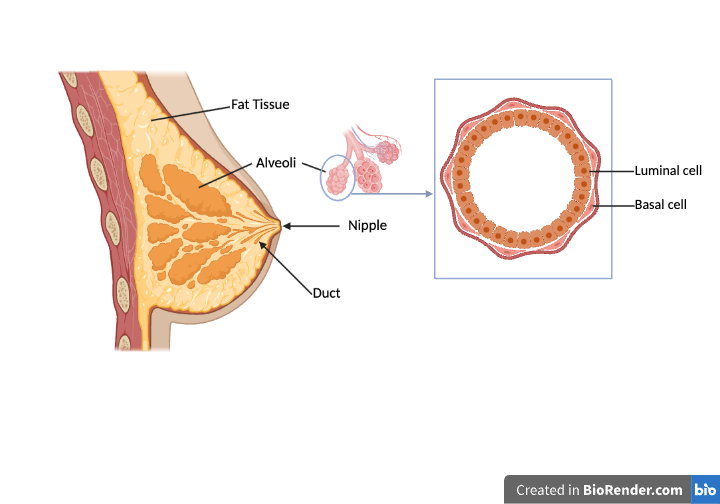
Figure 1. Non-tumorigenic Mammary Gland Components. A diagram of a non-tumorigenic mammary gland showing a cluster of alveoli containing luminal and basal cells. Luminal cells line the milk ducts and alveoli and are responsible for milk secretion during lactation. Basal cells are believed to play a role in transporting milk to the nipple during lactation. Source: Created in BioRender, [4], [10], [11].

In the normal mammary gland, various types of cells carry out specific functions, one of which is the progenitor cells. These progenitor cells generate distinct alveolar structures that continuously form in the adult breast, and their activity is crucial for maintaining normal mammary homeostasis [5]. Progenitor cells are located in the luminal compartment [6], which is also home to the luminal cells. The luminal cells play a key role in lactation by lining the milk ducts and alveoli, where they secrete milk (Figure 1)[7]. In contrast, basal cells are located around the luminal cells and are believed to function during lactation by helping to transport milk to the nipple (Figure 1)[7]. Although these mammalian epithelial cells (luminal and basal cells) are important to the function of normal mammary glands, these also serve as a tumour cell of origin [4].

In their study, Mahendralingam et al. used mass spectrometry to analyze the metabolic profiles of normal human mammary cells [8]. They discovered that luminal progenitor cells primarily rely on oxidative phosphorylation for energy, whereas basal cells depend more on glycolysis [4]. This distinction is crucial because oxidative phosphorylation is an efficient, oxygen-dependent process that generates substantial energy, while glycolysis, though faster, is less efficient and does not require oxygen — a pathway often favored by cancer cells to support rapid growth [9]. Targeting these distinct energy pathways could lead to more effective treatments for different breast cancer subtypes.

However, a new discovery was that breast cancer cells appear to adopt the metabolic programs of their cells of origin [4,9]. This complicates treatment since the cancer cells may still be vulnerable to metabolic pathways that are important for normal cell function. As a result, treatments designed to target specific metabolic pathways might not work as expected, since the cancer cells might behave similarly to the healthy cells from which they originated. 

The results from Mahendralingam et al. can form a basis for future metabolic studies that may lead to specific anti-tumoral drug therapies designed to treat specific breast cancer subtypes. This type of research lays a foundation for targeted approaches but further studies are needed to assess how findings, such as this one, can translate into clinical practice. As breast cancer continues to rise, understanding the complexity is more important than ever. 


Work Cited: 

  1. Global Cancer Facts & Figures. (n.d.). Retrieved October 27, 2024, from https://www.cancer.org/research/cancer-facts-statistics/global-cancer-facts-and-figures.html
  2. Global cancer burden growing, amidst mounting need for services. (n.d.). Retrieved October 27, 2024, from https://www.who.int/news/item/01-02-2024-global-cancer-burden-growing–amidst-mounting-need-for-services
  3. Sánchez López de Nava, A., & Raja, A. (2024). Physiology, Metabolism. In StatPearls. StatPearls Publishing. http://www.ncbi.nlm.nih.gov/books/NBK546690/
  4. Alfonso-Pérez, T., Baonza, G., & Martin-Belmonte, F. (2021). Breast cancer has a new metabolic Achilles’ heel. Nature Metabolism, 3(5), 590–592. https://doi.org/10.1038/s42255-021-00394-8
  5. Tharmapalan, P., Mahendralingam, M., Berman, H. K., & Khokha, R. (2019). Mammary stem cells and progenitors: Targeting the roots of breast cancer for prevention. The EMBO Journal, 38(14), e100852. https://doi.org/10.15252/embj.2018100852
  6. Tornillo, G., & Smalley, M. J. (2015). ERrrr…Where are the Progenitors? Hormone Receptors and Mammary Cell Heterogeneity. Journal of Mammary Gland Biology and Neoplasia, 20(1–2), 63–73. https://doi.org/10.1007/s10911-015-9336-1
  7. New Paradigm for Mammary Glands. (n.d.). Massachusetts General Hospital. Retrieved December 8, 2024, from https://www.massgeneral.org/cancer-center/clinician-resources/advances/new-paradigm-for-mammary-glands
  8. Mahendralingam, M. J., Kim, H., McCloskey, C. W., Aliar, K., Casey, A. E., Tharmapalan, P., Pellacani, D., Ignatchenko, V., Garcia-Valero, M., Palomero, L., Sinha, A., Cruickshank, J., Shetty, R., Vellanki, R. N., Koritzinsky, M., Stambolic, V., Alam, M., Schimmer, A. D., Berman, H. K., … Khokha, R. (2021). Mammary epithelial cells have lineage-rooted metabolic identities. Nature Metabolism, 3(5), 665–681. https://doi.org/10.1038/s42255-021-00388-6
  9. ZHENG, J. (2012). Energy metabolism of cancer: Glycolysis versus oxidative phosphorylation (Review). Oncology Letters, 4(6), 1151–1157. https://doi.org/10.3892/ol.2012.928
  10. Fig. 3 Stem cell in glandular and stratified epithelia. A A schematic… (n.d.). ResearchGate. Retrieved December 7, 2024, from https://www.researchgate.net/figure/Stem-cell-in-glandular-and-stratified-epithelia-A-A-schematic-model-depicting-the_fig3_374804603
  11. Model of normal mammary gland structure. This tissue is composed of… (n.d.). ResearchGate. Retrieved December 8, 2024, from https://www.researchgate.net/figure/Model-of-normal-mammary-gland-structure-This-tissue-is-composed-of-ducts-which-are_fig1_357239665

Filed Under: Biology, Chemistry and Biochemistry, Science Tagged With: Breast Cancer, Cancer Biology, Metabolic Pathways

Primary Sidebar

CATEGORY CLOUD

Biology Chemistry and Biochemistry Computer Science and Tech Environmental Science and EOS Honors Projects Math and Physics Psychology and Neuroscience Science

RECENT POSTS

  • From Pack to Patient: Improvising Stability in the Backcountry May 3, 2026
  • Between Concentration and Decentralization: The Changing Landscape of AI Power May 3, 2026
  • An Eight-Week Shot at Equality: Advancing Male Hormonal Contraceptives May 3, 2026

FOLLOW US

  • Facebook
  • Twitter

Footer

TAGS

AI AI ethics Alzheimer's Disease antibiotics artificial intelligence bacteria Bathymetry Biology brain Cancer Biology Cell Biology Chemistry and Biochemistry Chlorofluorocarbons climate change Computer Science and Tech CRISPR Cytoskeleton Depression Dermatology dreams emergency medicine epigenetics Ethics Genes Gut microbiota honors Marine Biology Marine Mammals Marine noise Medicine memory Montreal Protocol neurobiology neuron neuroscience Nutrients Ozone hole Psychology and Neuroscience REM seabirds sleep student Technology therapy Women's health

Copyright © 2026 · students.bowdoin.edu