Introduction
How does Aging work? This has been a question that has stumped scientists since the dawn of civilization. What are the causes and implications of Aging? Is it preventable or reversible? In “Longevity of Lobsters is Linked to Ubiquitous Telomerase Expression” by Klapper, Kühne, and others, they sought to investigate telomerase activity in animals that grow indeterminately. Lobsters (Homarus americanus) were the main subject of their study. Through their investigation of Telomerase activity, they found that, unlike most animals, lobsters continue to grow throughout their entire lives and that the onset of senescence (referring to cellular deterioration or aging) is slowed. The researchers discovered that telomerase was present throughout the lobster’s body, including many of its organs and tissues. Furthermore, they concluded that this high amount of telomerase activity throughout the body is what allows them to live such long lives; the life expectancy of Lobsters (Homarus americanus) is over 100 years (Geggel). This was a unique discovery because most animals, like Humans and other mammals, have telomerase found in limited areas of high cell turnover, such as gametes, to reduce the risk of unregulated division, also known as cancer (Robinson). This will be further elaborated upon later in this paper. So why should we care? How do these researchers’ findings of telomerase slowing aging help us? Well, the cool implications of telomerase research would be understanding how aging and cancer work. Could studying lobsters help scientists find safer ways to use telomerase to slow aging or aid tissue regeneration in humans? Or could we understand cancer well enough to eradicate it from humans?
Background: What is Telomerase, and how does it affect aging?
Before we dive into any of these big words, we need to explain some terms being discussed in this paper. Aging has been linked to chromosomal damage during cell division. Every time your body needs to grow new cells, your cells must divide. Each division causes small amounts of DNA damage. However, telomeres act like protective caps that shield the DNA inside your chromosomes every time your cells divide (Schumacher). Instead of damaging the chromosomes, the telomeres simply become shorter. After many years of cell division, telomeres can shorten, increasing the risk of chromosomal damage. Telomerase is an enzyme that helps regenerate telomeres by fixing the areas that were shortened. Through this process, certain species, like the Lobster, can avoid chromosomal damage and age much more slowly in comparison.
Earlier, I referenced how finding high amounts of Telomerase activity over a lobster’s entire body is atypical compared to other species. The reason for this is that telomerase is often linked to hyperproliferative cells, a term used to refer to cells that grow abnormally fast. This is helpful for animals that grow continuously, like lobsters and axolotls (Springhetti), but can be extremely harmful to other organisms because hyperproliferative cells can be cancerous. In humans, for example, we have small amounts of telomerase outside our gametes and stem cells because our bodies avoid our cells becoming cancerous. In Robinson’s “Telomerase in cancer: Function, regulation, and clinical implications,” the author explains, “Cancer cells often up-regulate (produce more of) telomerase to sustain indefinite division.” This same attribute that makes cancerous cells so dangerous, the ability to sustain indefinite division, is what makes organisms like lobsters and axolotls so good at regenerating.
So why is this important? When we understand how telomerase maintains chromosome integrity, we gain insight into both the aging process and the mechanisms that allow cancer to thrive.
Method & Results
How did these researchers determine that lobsters have telomerase activity throughout their bodies? They did this through a series of experiments. First, they extracted tissue from a lobster to analyze it. Then they used a TRAP (Telomeric Repeat Amplification Protocol) assay to identify where telomerase is active. The way that TRAP works is that TS primers (tiny pieces of DNA) are created to bind to the ends of telomerase. There is a test on humans where telomerase adds TTAGGG, but lobster telomerase adds TAGG (so they changed the test to match lobster telomeres). So if lobster telomerase is active, it will do something like: TS primer → TAGG TAGG TAGG TAGG… If the lobster has no telomerase, nothing gets added; in this sense, the primer acts kind of like a tag to help researchers find where and how concentrated telomerase is. You can’t see these tiny repeats directly, so they run PCR (a method to make millions of copies of a specific piece of DNA) to amplify and analyze the tags.
The results of this test indicated that in all the tissues extracted from the lobsters, there was telomerase present. Certain organs, such as the hepatopancreas (a digestive organ) and the heart, exhibited really high levels of telomerase expression, although telomerase was found in high concentrations throughout their entire bodies (Figure 1). The continuous presence of telomerase throughout its body was found to slow down the aging process and increase regeneration in lobsters. This raised the question of how lobster telomerase compares to human and other known telomerases, and so the researchers performed a test, heat and RNase (which destroys RNA) inactivated telomerase, confirming it functions like other known telomerases.
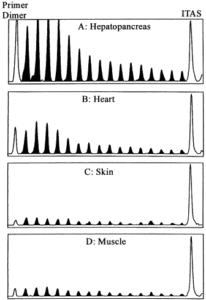
Figure 1: These are the results from the TRAP Assay. High telomerase activity was seen throughout the body, but there were exceptionally high amounts of telomerase present in areas like the Hepatopancreas (A) and the Heart (B). The location of the peak along the x-axis illustrates the size of the sequence (TAGG), with the smallest sequence on the left. The peak amplitude shows the concentration of the primer binding to the telomerase found in the area, thus showing the concentration of the telomerase in that area. Overall, the figure shows that there are large concentrations of telomerase in the smaller telomerase products, as there were high amounts of primer binding to these areas.
Broader Implications and Reflections
Understanding how lobsters maintain high amounts of telomerase activity throughout their bodies opens several routes of understanding telomerase in other organisms. Studying the regulation of telomerase in long-lived, indeterminately growing species may help scientists understand how to implement and understand continuous regeneration without the negative sides of uncontrolled cell division. Robinson, in their paper “Telomerase in cancer: Function, regulation, and clinical implications. Cancers,” said “Cancer cells often up-regulate telomerase (or activate the alternative lengthening of telomeres, ALT) to sustain indefinite division.” Researching these regulatory mechanisms can help us understand how to safely activate telomerase in human tissues for therapeutic purposes, such as improving wound healing, organ repair, or treatments for degenerative diseases.
Furthermore, comparing the telomerase in lobsters to humans may reveal some differences that explain why one supports regeneration while the other is closely linked to cancer. This could help us design a way of inhibiting the negative cancer-related telomerase or activating the regeneration-related telomerase to help combat aging. By investing more into understanding how telomerase works within different species, we could combat some of humanity’s oldest ailments and ultimately contribute to new biomedical technologies that enhance human health span.
Citations:
Klapper, Wolfram, et al. “Longevity of Lobsters Is Linked to Ubiquitous Telomerase Expression.” FEBS Letters, vol. 439, no. 1–2, 1998, pp. 143–146. Elsevier
https://www.sciencedirect.com/science/article/pii/S001457939801357X
Laura Geggel, “Do Lobsters Live Forever?” 2016
https://www.livescience.com/55392-do-lobsters-live-forever.html
Schumacher, B., Pothof, J., Vijg, J., & Hoeijmakers, J. H. J. (2021). The central role of DNA damage in the ageing process. Nature, 592(7856), 695-703
https://pmc.ncbi.nlm.nih.gov/articles/PMC9844150/
Cong, Y. S., Wright, W. E., & Shay, J. W. (2002). Human telomerase and its regulation. Microbiology and Molecular Biology Reviews, 66(3), 407-425.
https://pmc.ncbi.nlm.nih.gov/articles/PMC120798/
Robinson, N. J. (2022). Telomerase in cancer: Function, regulation, and clinical implications. Cancers, 14(3), 808.
https://pmc.ncbi.nlm.nih.gov/articles/PMC8834434/
Springhetti, S., Bucan, V., Liebsch, C., Lazaridis, A., Vogt, P. M., & Strauß, S. (2022). An identification and characterization of the axolotl (Ambystoma mexicanum, Amex) telomerase reverse transcriptase (Amex TERT). Genes, 13(2), 373.