• Skip to primary navigation
  • Skip to main content
  • Skip to primary sidebar
  • Skip to footer

Bowdoin Science Journal

  • Home
  • About
    • Our Mission
    • Our Staff
  • Sections
    • Biology
    • Chemistry and Biochemistry
    • Math and Physics
    • Computer Science and Technology
    • Environmental Science and EOS
    • Honors Projects
    • Psychology and Neuroscience
  • Contact Us
  • Fun Links
  • Subscribe

Ella Scott '28

Phytoplankton and Ocean Warming: Uneven Adaptations at the Base of the Marine Food Web

December 7, 2025 by Ella Scott '28


Global warming is steadily transforming Earth’s oceans. Between 1901 and 2023, sea surface temperatures have increased at an average rate of 0.14℉ per decade (US EPA, 2016). This seemingly small thermal shift is enough to disrupt circulation patterns, alter nutrient availability, and restructure entire marine communities. As oceans absorb over 90% of excess atmospheric heat, they become both a buffer against and a victim of climate change (Climate Change, 2025). Among the many organisms affected by these changes, phytoplankton—the microscopic, photosynthetic organisms that drift near the ocean’s surface—serve as a critical case study. These single-celled producers are responsible for about half of Earth’s oxygen production, and they form the foundation of aquatic food webs, converting sunlight into chemical energy that sustains nearly all marine life (Hook, 2023). Therefore, understanding how phytoplankton respond to warming is essential for predicting the future of marine ecosystems.

Phytoplankton are highly sensitive to temperature fluctuations. Since their metabolic processes, growth rates, and enzymatic activities are temperature-dependent, even minor thermal changes can reshape their abundance and distribution. When waters warm beyond a species’ thermal tolerance, populations may decline or shift toward cooler regions (Barton et al., 2016). At the microscopic level, these shifts can cascade upward through the food web, reducing food availability for zooplankton, fish, and the higher-level predators that feed on them, such as sharks, whales, and seals. However,  one key question remains: can phytoplankton adapt to rising temperatures, or will their thermal limits determine the structure of future marine ecosystems?

Huertas et al. (2011) directly addressed this question through controlled laboratory experiments designed to measure the capacity of phytoplankton to evolve under warming. The researchers selected twelve species representing a range of environments—freshwater, coastal, open-ocean, and coral symbiotic systems—to test whether thermal tolerance varied among ecological types. To simulate long-term warming, they employed a “ratchet technique,” in which phytoplankton populations were gradually exposed to higher temperatures. Each population started from a single cloned cell to remove preexisting genetic variation. Then, the cell cultures were repeatedly grown and transferred into warmer conditions, forcing the populations to either adapt to the changes through genetic mutations or face extinction.

The results revealed striking differences among species. Freshwater species, such as Scenedesmus intermedius, exhibited remarkable resilience, adapting to temperatures as high as 40°C. Coastal species like Tetraselmis suecica and Dictyosphaerium chlorelloides tolerated up to 35°C, while open-ocean species such as Emiliania huxleyi and Monochrysis lutheri showed little to no capacity for adaptation. Coral symbionts (Symbiodinium species) demonstrated limited but detectable resistance, reflecting the thermal stress already observed in coral reef environments. Importantly, adaptation was not simply a case of short-term acclimation. The researchers found that resistant populations arose at different times across replicate cultures. This serves as evidence that adaptation stemmed from rare, spontaneous genetic mutations instead of physiological flexibility. Growth rates of adapted populations diverged significantly from their ancestral strains, confirming that true evolutionary change had occurred.

These findings carry major implications for understanding the ecological future of the oceans. If phytoplankton species differ so widely in their ability to adapt, warming will likely reorganize marine communities from the bottom up. Species capable of rapid genetic adaptation may dominate, while others could decline or disappear. This uneven resilience could favor smaller, faster-growing species, altering nutrient cycling and potentially weakening the ocean’s ability to sequester carbon. Because phytoplankton drive roughly half of global primary production, any restructuring of these communities could ripple through food webs, climate regulation, and fisheries.

While Huertas et al. focused on individual species in controlled conditions, Poloczanska et al. (2016) broadens this picture to the scale of global ecosystems. Their review synthesized nearly 2,000 observations of marine organisms responding to climate change, confirming that uneven adaptation is already occurring across taxa and ocean regions. On average, species distributions are shifting towards the north and south poles by about 72 kilometers per decade, and spring life-cycle events such as breeding or migration are advancing by four days per decade. Warm-water species are becoming more abundant, while cold-water species decline. Coral calcification, the process by which corals take in calcium and carbonate ions to build their exoskeletons, is weakening under combined warming and acidification stress. These patterns mirror the interspecific variability observed by Huertas et al.; some organisms adjust successfully to changing conditions, while others falter. Here, the broader conclusion is that climate change does not affect marine life uniformly—it selectively reshapes communities based on biological flexibility, dispersal ability, and evolutionary potential.
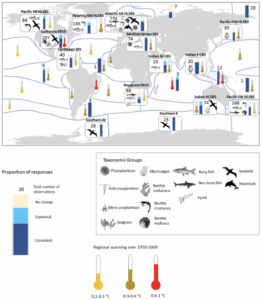
Fig 1. Global distribution of documented marine biological responses to climate change across major ocean regions (Poloczanska et al., 2016). Bars show the proportion of observed responses as consistent (dark blue), equivocal (light blue), or no change (yellow). Numbers indicate total observations per region; symbols identify taxa with ≥10 observations. Background colors represent regional sea-surface warming from 1950–2009 (yellow: low; orange: medium; red: high). Regions are defined by ecological structure and oceanographic features. eveal that climate-driven shifts in abundance, distribution, and phenology vary sharply across ocean basins—mirroring the uneven adaptive capacities described by Huertas et al. (2011).

Together, these studies illustrate both the mechanisms and the consequences of ocean warming. Huertas et al. provides mechanistic insight—showing that adaptation in phytoplankton depends on genetic change, and that some species are inherently more capable than others. Building off of this, Poloczanska et al. reveals how these species-level differences scale up, driving global shifts in abundance, distribution, and ecosystem structure. The two perspectives complement one another; laboratory experiments explain how adaptation might occur, while global syntheses show where and to what extent it already has.

As climate change accelerates, understanding the adaptability of foundational organisms like phytoplankton becomes increasingly urgent. Their evolutionary potential will determine not only the structure of marine ecosystems, but also the ocean’s capacity to regulate the planet’s climate. By linking experimental evidence with global ecological trends, researchers are beginning to map out a future ocean defined by winners and losers—a mosaic of adaptation, migration, and loss. The challenge ahead lies in predicting how these microscopic shifts will ripple through the web of life that depends on them.


References:

Barton, A. D., Irwin, A. J., Finkel, Z. V., & Stock, C. A. (2016). Anthropogenic climate change drives shift and shuffle in North Atlantic phytoplankton communities. Proceedings of the National Academy of Sciences, 113(11), 2964–2969. https://doi.org/10.1073/pnas.1519080113 

Climate Change: Ocean Heat Content | NOAA Climate.gov. (2025, June 26). https://www.climate.gov/news-features/understanding-climate/climate-change-ocean-heat-content 

Hook, B. (2023, May 31). Phenomenal Phytoplankton: Scientists Uncover Cellular Process Behind Oxygen Production | Scripps Institution of Oceanography. https://scripps.ucsd.edu/news/phenomenal-phytoplankton-scientists-uncover-cellular-process-behind-oxygen-production 

Huertas, I. E., Rouco, M., López-Rodas, V., & Costas, E. (2011). Warming will affect phytoplankton differently: Evidence through a mechanistic approach. Proceedings of the Royal Society B: Biological Sciences, 278(1724), 3534–3543. https://doi.org/10.1098/rspb.2011.0160 

Poloczanska, E. S., Burrows, M. T., Brown, C. J., García Molinos, J., Halpern, B. S., Hoegh-Guldberg, O., Kappel, C. V., Moore, P. J., Richardson, A. J., Schoeman, D. S., & Sydeman, W. J. (2016). Responses of Marine Organisms to Climate Change across Oceans. Frontiers in Marine Science, 3. https://doi.org/10.3389/fmars.2016.00062 

US EPA, O. (2016, June 27). Climate Change Indicators: Sea Surface Temperature [Reports and Assessments]. https://www.epa.gov/climate-indicators/climate-change-indicators-sea-surface-temperature 


Filed Under: Biology, Environmental Science and EOS, Science

Airborne Bacteria: A Hidden Regulator of Ocean Blooms

May 4, 2025 by Ella Scott '28

Context

Marine phytoplankton are microscopic algae integral to oceanic ecosystems and global biogeochemical cycles. They contribute significantly to the process of carbon displacement into the deep ocean and primary production, forming the foundation of the marine food web. However, these phytoplankton populations are vulnerable to various environmental and biological stressors, including temperature changes, nutrient availability, and pathogen infections. When a phytoplankton bloom collapses, bacteria consume their organic matter, a process that requires oxygen. The decay of the bloom and oxygen levels can deplete oxygen and lead to “dead zones” that can suffocate marine life (US EPA, 2013). Researching the components of bloom dynamics enables us to better understand their interactions as a foundation of the food web and regulator of oxygen levels.


Fig 1. Demise of a phytoplankton bloom over the course of a handful of days (Demise of a Phytoplankton Bloom, 2014)

One of the most abundant bloom-forming phytoplankton is Gephyrocapsa Huxley, a species of coccolithophore, a type of phytoplankton covered in calcium carbonate plates known for its widespread blooms in the ocean. While viral infections have long been recognized as a primary cause of phytoplankton bloom collapse, researchers have questioned whether bacteria could be another potential source of pathogenicity. Recent research regarding G. huxleyi phytoplankton suggests so.


Fig 2. Calcium carbonate plating on a coccolithophore phytoplankton (Briggs, 2021)


This groundbreaking study by Lang-Yona et al. investigated whether airborne bacteria could infect G. huxleyi blooms and be an explanation for bloom collapses. This research aimed to analyze atmospheric bacteria as an ecological regulator of phytoplankton populations, an often disregarded consideration in the dynamics of oceanic microbial interactions and climate models. Understanding these interactions is critical for predicting changes in marine ecosystems and their impact on global carbon cycles.

Methods of the Study

To explore whether airborne bacteria play a role in controlling phytoplankton populations, researchers collected air and water samples above a bloom of G. huxleyi in the North Atlantic. They conducted this work aboard the research vessel R/V Tara, using specialized instruments to capture airborne bacteria at different heights. These included high-volume air samplers and devices called cascade impactors, which were set up at different points on the ship, including the deck and mast. This setup allowed them to collect bacteria from various altitudes and better understand how microbes travel through the air (Lang-Yona et al., 2024)

Back in the lab, the team introduced the airborne bacteria into cultures of G. huxleyi to see what would happen. They carefully watched for signs of infection, such as a drop in the algae’s natural fluorescence (a sign they were losing their ability to photosynthesize), increased debris in the water (indicating cell death), and visible damage to the algal cells. When signs of infection appeared, they filtered out the bacteria from the cultures and grew them on a nutrient-rich surface called Marine Agar 2216. This step helped them isolate specific bacterial strains. To confirm that these bacteria were truly responsible for the infection, they then reintroduced them to fresh G. huxleyi cultures and checked whether the same effects occurred.

To track how the bacteria and algae interacted over time, researchers used a technique called flow cytometry. This method shines a laser through tiny droplets of water containing cells, measuring their size, shape, and natural glow. It allows scientists to quickly count how many algae and bacteria are present and determine how the infection is progressing.

Finally, they identified the bacteria using genetic sequencing and measured their presence in air and water samples with a technique called quantitative PCR (qPCR). This method detects and counts bacterial DNA, helping researchers understand how common these airborne microbes are in different environments.

Results of the Study and Implications

The study identified the airborne bacterium Roseovarius nubinhibens as a key bacteria capable of infecting and contributing to the collapse of G. huxleyi blooms. This bacterium was found to remain viable after atmospheric transport and effectively infects phytoplankton upon reaching ocean waters. The ability of R. nubinhibens to survive and remain pathogenic after airborne dispersal suggests a more dynamic role for bacteria in ocean-atmosphere interactions than previously recognized.

The ability of bacteria to be transported via wind patterns indicates a geologically vast and major mechanism that has previously been overlooked. The findings suggest that in addition to viral infections, bacterial pathogens may serve as natural regulators of phytoplankton populations, influencing bloom duration and oceanic carbon cycling. This discovery is particularly significant because phytoplankton blooms play a critical role in the global carbon cycle by taking carbon from the atmosphere, and upon death, sinking to the deep ocean where the carbon is stored. If bacterial infections contribute to bloom collapse and can be dispersed so vastly,  they may influence carbon fluxes in ways that need to be accounted for in climate models.

Previously, viral infections were considered the primary biological driver of bloom decline, but this study introduces airborne bacteria as an additional player in phytoplankton mortality. This raises important questions about how environmental factors such as wind patterns and ocean currents influence bacterial dispersal. Additionally, climate change may impact the spread of airborne pathogens, potentially altering bloom dynamics in unforeseen ways. A warming climate and shifting atmospheric circulation patterns could enhance or suppress the spread of algicidal bacteria, with cascading effects on marine ecosystems.

Furthermore, this research highlights the complexity of microbial interactions in the ocean. Many bacterial species exhibit “Jekyll-and-Hyde” dynamics, shifting between mutualism and pathogenicity depending on environmental conditions and the physiological state of their algal hosts. In the case of R. nubinhibens, it is possible that under certain conditions, it exists in a neutral or even beneficial relationship with G. huxleyi, but when environmental factors such as nutrient depletion or increased bacterial density trigger a shift, it becomes pathogenic. The study’s infection experiments demonstrated that R. nubinhibens could rapidly induce algal demise, suggesting a transition from a benign to an algicidal state. This aligns with previous findings that some marine bacteria can switch between cooperative and harmful interactions based on chemical signaling. Understanding these complex interactions is essential for developing a more accurate picture of microbial regulation in marine environments, as such shifts can significantly alter bloom dynamics and oceanic food webs.

This study provides new insight into the role of airborne bacteria in regulating marine phytoplankton populations, demonstrating that Roseovarius nubinhibens can contribute to G. huxleyi bloom collapse. These findings expand our understanding of ocean-atmosphere microbial interactions and introduce airborne bacteria as an important but previously overlooked factor in bloom dynamics. Incorporating airborne bacterial processes into ecological and climate models will be crucial for accurately predicting future oceanic changes. Further research is necessary to determine whether other phytoplankton species are similarly affected and how environmental shifts may influence the prevalence and impact of airborne bacterial infections on marine ecosystems. Understanding these dynamics is essential for assessing ocean health and resilience in a rapidly changing climate.


References:

Briggs, G. M. (2021). Coccolithophores, photosynthetic unicellular algae. https://milnepublishing.geneseo.edu/botany/chapter/emiliana-huxleyi/

Demise of a Phytoplankton Bloom. (2014, November 26). [Text.Article]. NASA Earth Observatory. https://earthobservatory.nasa.gov/images/84797/demise-of-a-phytoplankton-bloom

Lang-Yona, N., Flores, J. M., Nir-Zadock, T. S., Nussbaum, I., Koren, I., & Vardi, A. (2024). Impact of airborne algicidal bacteria on marine phytoplankton blooms. The ISME Journal, 18(1), wrae016. https://doi.org/10.1093/ismejo/wrae016

US EPA, O. (2013, March 12). The Effects: Dead Zones and Harmful Algal Blooms [Overviews and Factsheets]. https://www.epa.gov/nutrientpollution/effects-dead-zones-and-harmful-algal-blooms


Filed Under: Biology, Environmental Science and EOS Tagged With: bacteria, phytoplankton

Sunshine, Sea, and Sunscreen: How ‘Eco-Friendly’ Choices Affect Marine Life

December 8, 2024 by Ella Scott '28

Since the onset of the COVID-19 pandemic in 2020, international tourism has slowly been returning to previous levels. As of July 2024, an estimated 790 million tourists have traveled internationally, marking an 11% increase from the prior year and approaching the frequency of pre-COVID travel (Global Tourism Statistics). While this rise sounds promising for economic stimulation and cultural preservation, it also reintroduces the environmental impacts associated with tourism. In the Mediterranean, for example, tourists seeking to enjoy sunny beach days may unknowingly disrupt local ecosystems through their sunscreen use. Knowing how our consumption and product use impacts environmental systems is a key factor in being able to pinpoint where environmental degradation is coming from, and being able to stop it at the source. This raises the question: do “eco-friendly” sunscreens truly provide a safer alternative?

Pedro Echeveste, a researcher in marine microbial ecology and ecotoxicology at the University of the Balearic Islands, and his team have investigated this topic. Their 2024 study focused on commercial sunscreens and their chemical components’s impact on bacterial communities linked to Posidonia oceanica, or Neptune grass, a foundational species in the Mediterranean ecosystem (Echeveste et al., 2024).

Figure 1. Overview of all experimental results. The image shows all the different types of bacteria and epiphytes tested, and how their cell abundance shifted based on the type of sunscreen added to their system (Echeveste et al., 2024).

The study examined both heterotrophic bacteria (including Pseudomonas azotifigens, Marinobacterium litorale, Thiothrix nivea, Sedimentiacola thiotaurini, and Cobetia sp.) and autotrophic bacteria (Halothece sp. and Fischerella muscicola), as well as epiphytes—plants growing on the leaves of Neptune grass without being parasitic. These bacterial communities were cultured in artificial seawater at 25°C, with a 12-hour light/dark cycle and an initial concentration of 10^5 bacteria per mL. The research team added various concentrations of nanoparticles and sunscreens (0, 0.01, 0.1, 1, 10, and 100 mg/L) to each sample, exposing the bacterial communities for 72 hours.

Two commonly used inorganic UV filters, titanium dioxide (TiO₂) and zinc oxide (ZnO), were tested due to their prevalence in commercial sunscreens. The study focused on three sunscreen types: an eco-friendly SPF 50 without nanoparticles (SPF50E), an SPF 50 containing TiO₂ nanoparticles (SPF50), and an SPF 90 with both TiO₂ and ZnO nanoparticles (SPF90).

After the 72-hour exposure, the pollution concentrations that led to a 10% population decline (known as the EC10 value) were recorded. Titanium dioxide proved toxic to all heterotrophic bacteria, with Thiothrix nivea exhibiting a 10% decline at a concentration of 3.8 mg/L. Zinc oxide was comparatively less harmful, affecting only Marinobacterium litorale and Pseudomonas azotifigens at an EC10 of 1.39 mg/L for the latter.

The effects varied among the sunscreen types. The eco-friendly SPF 50 reduced phosphorus uptake by 30-50% in most bacterial species, a significant alteration that suggests interference with key nutrient cycles. The regular SPF 50, containing TiO₂, decreased alkaline phosphatase (APA) activity, an enzyme necessary for cell communication via dephosphorylation. Dephosphorylation—the removal of a phosphate group—is a critical process for signal transmission within cells. All sunscreens in the study also led to increased levels of reactive oxygen species (ROS), molecules derived from oxygen that may damage cellular proteins, DNA, and other essential structures. This data allows us to assume that any form of sunscreen, no matter the label as “eco-friendly”, or the SPF value, can impose degradational effects on our environmental systems via one mode or another.

All in all, These findings reveal that eco-friendly labels sometimes lack scientific backing, failing to account for subtle but important factors in maintaining environmental balance. Even the “eco-friendly” SPF 50 sunscreen altered bacterial populations, calling into question the validity of eco-friendly claims. 

As tourism resumes in coastal areas, the increased use of sunscreens—and thus UV filters—places greater pressure on marine ecosystems (Raffa et al., 2018). This rise in sunscreen pollution underscores the importance of studying the effects of “eco-friendly” sunscreens, as even minor shifts in bacterial populations can compound into substantial ecosystem changes when multiplied by millions of beachgoers. Achieving a truly eco-friendly sunscreen remains a challenge, but as consumers, what we can do is adopt a more informed and thoughtful approach to product choices. By balancing our personal protection needs with the planet’s health, we can work toward solutions that better align with environmental preservation.


References:

  1. Un tourism: Bringing the world closer. UN Tourism World Tourism Barometer | Global Tourism Statistics. Available at: https://www.unwto.org/un-tourism-world-tourism-barometer-data#:~:text=International%20tourist%20arrivals%20hit%2096,4%25%20less%20than%20in%202019 (Accessed: 28 October 2024). 
  2. Echeveste, P., Fernández-Juárez, V., Brito-Echeverría, J., Rodríguez-Romero, A., Tovar-Sánchez, A., & Agawin, N. S. (2024). Toxicity of inorganic nanoparticles and commercial sunscreens on marine bacteria. Chemosphere, 364, 143066. https://doi.org/10.1016/j.chemosphere.2024.143066
  3. Raffa, R.B. et al. (2018) Sunscreen bans: Coral reefs and skin cancer, Wiley Journal of Clinal Pharmacy and Therapeutics. Available at: https://research.ebsco.com/c/ceyvtd/viewer/pdf/db53bg7blv (Accessed: 28 October 2024).


Filed Under: Biology, Environmental Science and EOS

Primary Sidebar

CATEGORY CLOUD

Biology Chemistry and Biochemistry Computer Science and Tech Environmental Science and EOS Honors Projects Math and Physics Psychology and Neuroscience Science

RECENT POSTS

  • Venom As Medicine: Novel Pathways for Dravet Syndrome Treatment Using Modulatory Peptides from Scorpion Venom January 8, 2026
  • When Distraction Helps: Music as a Tool for Focus in ADHD Cases December 24, 2025
  • Timing Matters: How the menstrual cycle influences ACL injury in Female athletes December 24, 2025

FOLLOW US

  • Facebook
  • Twitter

Footer

TAGS

AI AI ethics Alzheimer's Disease antibiotics artificial intelligence bacteria Bathymetry Biology brain Cancer Biology Cell Biology Chemistry and Biochemistry Chlorofluorocarbons climate change Computer Science and Tech CRISPR Cytoskeleton Depression Dermatology dreams epigenetics Ethics Genes Gut microbiota honors Marine Biology Marine Mammals Marine noise Medicine memory Montreal Protocol Moss neurobiology neuroscience Nutrients Ozone hole Plants Psychology and Neuroscience REM seabirds sleep student Technology therapy Women's health

Copyright © 2026 · students.bowdoin.edu