The effects of traumatic experiences are known to have various consequences on a person’s life. However, what is less commonly studied is the impact of maternal traumatic experiences or maternal stress on future generations. A recent 2025 study “Epigenetic signatures of intergenerational exposure to violence in three generations of Syrian refugees” conducted by Connie J. Mulligan et al. looks at maternal trauma, stress, and exposure to violence in three generations of Syrian mothers to study the epigenetic impact of violence on future offspring. Mothers exposed to traumatic violence while pregnant have the potential to genetically impact offspring through epigenetic modification. This type of genetic modification causes changes to cellular gene expression through the mechanism of DNA methylation (DNAm), which refers to the addition of a methyl group to a DNA sequence. For instance, DNAm plays a role in cellular differentiation and development, so that the function of cells is determined. This means that even though all your cells have the same genes, different expression in each cell means that you can have muscle cells and nerve cells (Centers for Disease Control and Prevention 2025). Relating to pregnancy, when a pregnant mother is lacking in nutrients, their baby could have different levels of DNAm, which could explain why they had an increased likelihood for certain diseases (Centers for Disease Control and Prevention 2025). Epigenetic modification can lead to increases or decreases in gene expression, which suggests that DNAm plays a role in controlling the impact of maternal trauma in offspring health outcomes.
In this study, maternal trauma is considered to be violent experiences that include being beaten, seeing someone else be beaten, shot, or killed. Additionally, maternal stressors include nutritional deficiencies, exposure to toxins, and psychosocial stressors like anxiety or trauma. These stressors can be transmitted from mother to offspring through cellular changes in the maternal and fetal stress response system, known as the HPA axes, and glucocorticoid metabolism, which allows the body to maintain and regulate stress hormones. The transmission of these stressors are associated with changes in newborn gene expression and epigenetic age acceleration or worse health outcomes. A developing fetus is characterized by high phenotypic plasticity, meaning that their genes are likely to produce different phenotypes, or physical characteristics determined by genetics, as a result of environmental factors. This allows a fetus to use environmental cues to determine an optimal phenotype to survive the postnatal environment, particularly if the mother is experiencing trauma or stressors.
This study specifically used the Developmental Origins of Health and Disease (DOHaD) hypothesis as a framework to look at epigenetic variation as a method of mediating the impact of psychosocial trauma on future generations. The DOHaD hypothesis states that early life adversity has an impact on later health outcomes; for instance, there are strong associations with low birthweight and adverse living conditions with an increased risk of cardiovascular disease in adulthood. This study looked at DNAm signatures of war-related violence across three generations of Syrian refugees by comparing germline, prenatal, and direct exposures to violence. The researchers proposed that there is a presence of differentially methylated positions (DMPs) in DNA that are sensitive to a psychosocial, and therefore violent, environment that are transmissible to future generations. In this study, the researchers propose the hypothesis that exposures to violence can lead to intergenerational epigenetic marks.
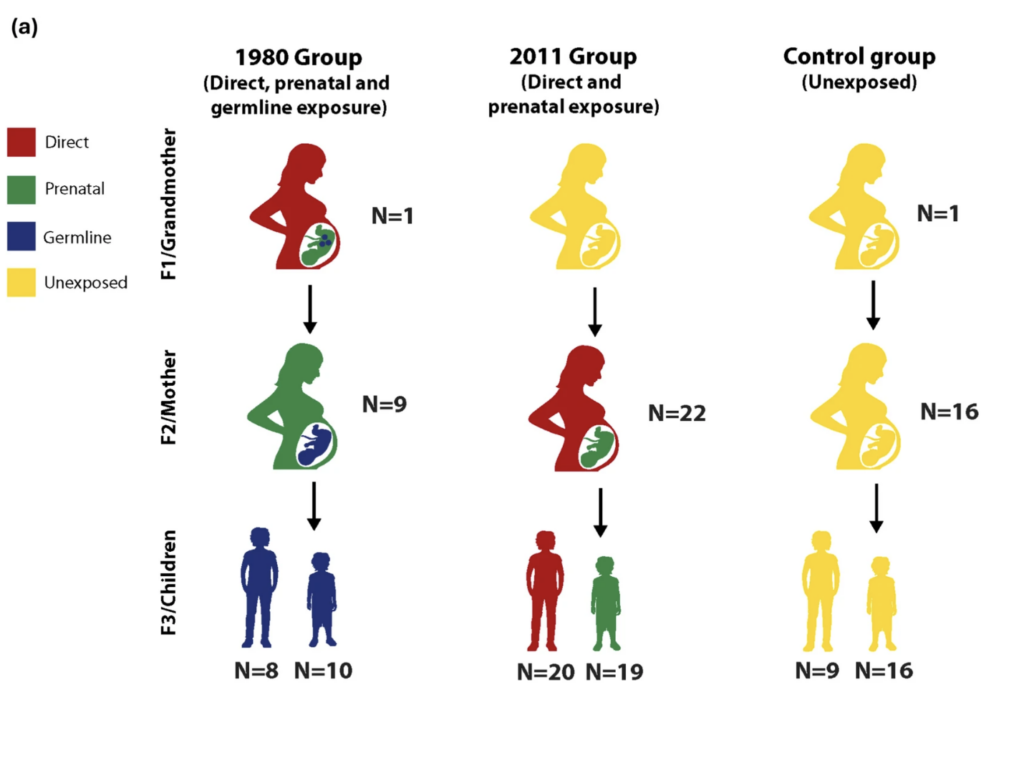
This study samples three groups of three-generation Syrian families with varying exposures to violence (Fig. 1). This study defined the exposure groups by using the regional conflicts of the Hama city massacre in 1980 and the Syrian uprising and armed conflicts beginning in 2011. The participants in this study were recruited in Jordan by snowball sampling, which is a method where research participants help researchers in finding other subjects (Oregon State University 2010). The Syrian women who participated had experienced violence and were pregnant during the 1980 or 2011 conflicts before fleeing to Jordan. Syrian families who moved to Jordan before 1980 and had not experienced exposure to violence were used as the control group.
Survey data and buccal swab samples were collected from the mothers and children for 10 families in the 1980 exposure group, 22 families in the 2011 exposure group and 16 families in the control group. A buccal swab is a method to non-invasively collect DNA from the cells inside of a person’s cheek. The buccal samples were collected using Transport swabs or DNA Buccal Swabs. The survey data consisted of an interview with the mothers and screening for traumatic events experienced by using the Traumatic Events Checklist. The researchers then calculated a trauma events score by counting the number of affirmative answers to the Traumatic Events Checklist. DNA methylation data was collected using a hybridizing technique to measure the genetic similarities between DNA sequences. Sensitivity analyses were used to test the robustness of their results to the distribution of age. Enrichment analysis was used to identify if any biological themes appeared more often than expected by chance, which would indicate what the modified genes would do. In addition, epigenetic age estimation was collected by analyzing DNAm patterns to determine biological age. To determine whether there was a linear relationship between DNAm and the amount of trauma events, DNAm was plotted against the cumulative number of violence trauma events.
This study had a three generation study design, which allowed for the DNAm signatures of various exposures to violence to be compared. The first exposure group was the 1980 group, which consisted of maternal grandmothers who were pregnant daughters (F2 generation) were prenatally exposed to violence and their grandchildren (F3 generation) were germline exposed to war violence. The 2011 exposure group included mothers (F2 generation) who were pregnant before fleeing Syria, so the fetus was prenatally exposed in utero and older children in the family (F3 generation) were directly exposed to violent conflict. The control group included Syrian mothers and grandmothers that lived in Jordan before 1980.
To generate DNAm data, an epigenome-wide association study (EWAS) was conducted to identify differentially methylated positions (DMPs) that were associated with each exposure to violence. The researchers identified that the final set of 35 DMPs had 14 sites that were associated with germline exposure to violence and 21 sites that were associated with direct exposure to violence. No DMPs were associated with prenatal exposure to violence. Additionally, 32 DMPs had the same directionality (Fig. 2).

The largest difference in DNAm compared to the control group was at a germline DMP at a site that produces keratin and has a potential role in some cancers. The highest DNAm was observed at the germline DNA and two directly associated DMPs, at a site with proteins that play a role in cell death. The germline-associated DMP showed a statistically significant reduction in DNAm in germline, direct, and prenatally exposed individuals. When the relationship between DNAm and the amount of violent trauma events was looked at, the plot suggested that most DMPs showed a dose-response relationship between DNAm and the amount of trauma events (Fig. 3).

After testing for epigenetic aging, there was a high correlation between epigenetic and chronological age in the study sample. Compared to children, the mothers had a higher variation in epigenetic age compared to chronological age. When analyzing the mothers, there was no significant association between epigenetic age acceleration and trauma exposure. However, when analyzing only the children, prenatal exposure to violence trauma was associated with epigenetic age acceleration.
This study suggests that the impacts of maternal stress and trauma can have effects on future generations through epigenetic mechanisms. The epigenetic marks on the DNA of mothers exposed to traumatic violent experiences, in the form of DNAm and DMPs, found in this study reveal that trauma has an effect on DNA expression. Thirty-two of all DMPs found showed a similar directionality of change in DNAm, which suggests that there is a common epigenetic signature of violence across germline, prenatal, and direct exposures to violence. The epigenetic marks found in this study may contribute to enhanced responses to future stressful experiences, which is also known as epigenetic “priming.” This means that genes are prepared to activate and quickly respond to future environmental cues.
Furthermore, the epigenetic marks could be used as biomarkers to identify individuals who could benefit from intervention programs. This study also identified that there is an association between epigenetic age acceleration and prenatal exposure to violence, which could be correlated with accelerated biological aging and with future health outcomes. For instance, environmental toxins may affect future generations more than those directly exposed (Korolenko et al. 2023).
To further investigate the effects of violence of intergenerational genetic marks, there needs to be research conducted on larger and more diverse population groups. There should also be studies that collect other types of body tissues or blood, since there can be tissue-dependent differences in DNAm. Additionally, it’s important to study other forms of epigenetic modifications, such as histone modifications or non-coding RNAs. This type of research is important because it allows refugees to be better understood and helps address the traumatic issues they face. Understanding the genetic mechanisms underlying trauma can encourage policymakers and humanitarian organizations to provide better resources to refugee populations.
Citations:
Centers for Disease Control and Prevention. 2025. Epigenetics, Health, and Disease. Genomics and Your Health. https://www.cdc.gov/genomics-and-health/epigenetics/index.html.
Korolenko AA, Noll SE, Skinner MK. 2023. Epigenetic Inheritance and Transgenerational Environmental Justice. The Yale Journal of Biology and Medicine. 96(2):241–250. doi:https://doi.org/10.59249/FKWS5176. https://www.ncbi.nlm.nih.gov/pmc/articles/PMC10303257/.
Mulligan, C.J., Quinn, E.B., Hamadmad, D. et al. Epigenetic signatures of intergenerational exposure to violence in three generations of Syrian refugees. Sci Rep 15, 5945 (2025). https://doi.org/10.1038/s41598-025-89818-z
Oregon State University. 2010. Snowball Sampling | Division of Research and Innovation. Division of Research and Innovation. https://research.oregonstate.edu/ori/irb/policies-and-guidance-investigators/guidance/snowball-sampling.